These free positivism books cover the idea that real knowledge comes from observable facts, from Auguste Comte's first lectures to the Vienna Circle and today's research methods.
Positivism is the 19th-century philosophy that wanted to study society the way physics studies nature. Here you'll find Comte's own books, John Stuart Mill's critical reading of him, the manifesto of Carnap, Neurath and Hahn, and the legal positivism of John Austin.
Each section follows one branch: classic, logical, legal, social science and post-positivism. Pick the one you need and download the PDFs for free, or read them online.
📚
Download every Positivism book on this page
All the books on this page in one ZIP file, instead of downloading them one by one.
We will redirect you to accounts.google.com to complete sign-in.
Email and name only · We never send spam
Access unlocked
Download every Positivism book on this page
All the books on this page in one ZIP file, instead of downloading them one by one.
Direct download · One ZIP file
Download started. Check your downloads folder for the ZIP.
Classic
Classic Positivism Books
Auguste Comte coined the word positivism and built a whole system around it, from the law of three stages to a religion of humanity. Start with The Positive Philosophy, then see how John Stuart Mill praised and criticized him.
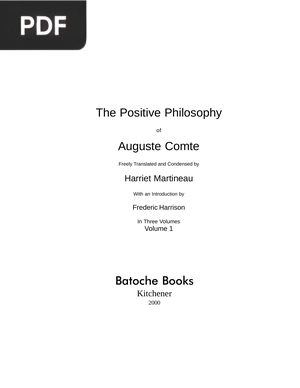
Harriet Martineau's condensed translation of Comte's Course of Positive Philosophy, the book that gave positivism its name. It walks through the law of three stages, the hierarchy of the sciences and the birth of sociology.
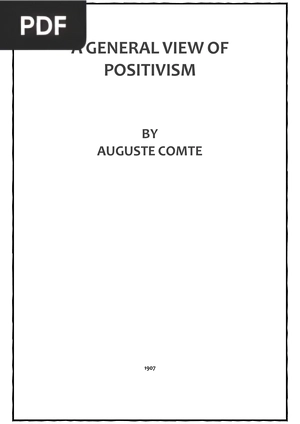
Comte's own overview of his system, written for a wide audience. It explains the intellectual and social side of positivism, its message to workers and women, its view of art and the Religion of Humanity.
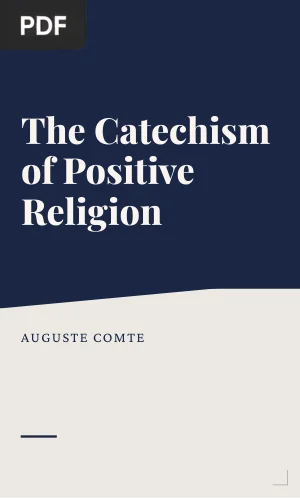
Comte sets out his Religion of Humanity as thirteen conversations between a woman and a priest, covering worship, doctrine and daily life. The complete 1858 translation by Richard Congreve.
Mill's famous two-part essay on Comte: high praise for the Course of Positive Philosophy and a sharp critique of the later religious system. The best short guide to what positivism got right and wrong.
A clear, complete study of Comte's thought, from his theory of knowledge and classification of the sciences to his sociology, morals and religion. Includes an introduction by the English positivist Frederic Harrison.
A university study unit that introduces positivism step by step: Comte's life and aims, the classification of the sciences, his sociology and Religion of Humanity, and the later rise of logical positivism. Includes review questions.
Mill's classic treatise on deduction, induction and scientific method, the logical backbone of 19th century positivism. It includes his famous methods of experimental inquiry and the logic of the moral sciences.
Brenner traces the French philosopher Abel Rey, whose absolute positivism inspired the Vienna Circle a generation before it existed. A useful bridge between Comte's tradition and logical positivism.
In 1920s Vienna, Schlick, Carnap and Neurath turned positivism into a theory of meaning: if a claim can't be verified, it says nothing. Wittgenstein's Tractatus was the book the Vienna Circle read line by line.
The 1929 manifesto of the Vienna Circle by Hahn, Neurath and Carnap. It lays out the scientific world view, the rejection of metaphysics and the program that became logical positivism.
Wittgenstein's short, numbered masterpiece on logic, language and the limits of what can be said, the book the Vienna Circle read line by line. The 1922 Ogden edition, with German and English text and Russell's introduction.
Philosopher of science John D. Norton explains how the Vienna Circle tied meaning to verification, from Schlick and Carnap to Ayer, and why the program gave way to logical empiricism. Clear and well paced.
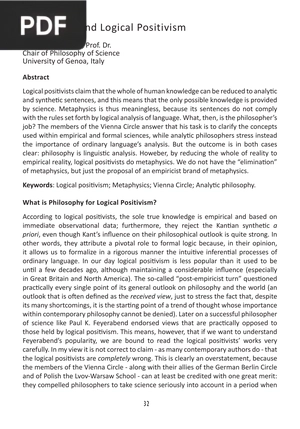
A compact introduction to logical positivism by Mauro Murzi: its origins, the verification principle, the analysis of science and the criticisms that followed.
Oxford lecture notes that map logical positivism in a few pages: the Vienna Circle, the verification principle, the analytic and synthetic distinction and the main objections.
A university study unit on logical positivism: its goals, the verification principle, the primacy of observation and a critical evaluation, with review questions at the end.
How logical positivism first reached the United States between 1929 and 1932, through Schlick, Feigl and Blumberg. A well documented history built on archive letters.
Legal positivism says a law is valid because of how it was made, not because it is moral. John Austin set out the idea in 1832, and H. L. A. Hart refined it a century later.
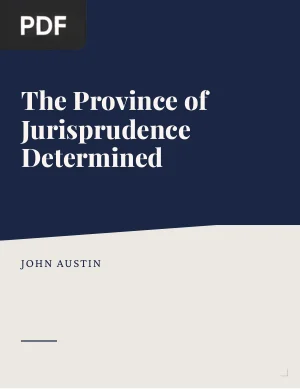
The founding text of legal positivism. Austin defines law as the command of a sovereign backed by sanctions and separates the law as it is from the law as it ought to be. First edition, 1832.
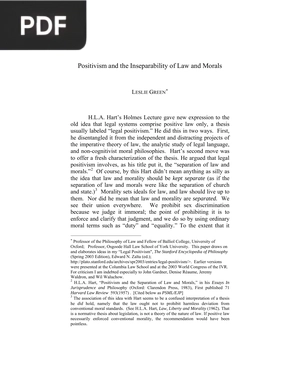
Leslie Green revisits H. L. A. Hart's separation of law and morals and argues that legal positivism is better read as a thesis about their inseparability.
Sociology was born positivist, since Comte wanted a science of society with laws as firm as those of physics. These positivism papers show how that idea shaped anthropology, psychology, statistics and economics.
Carl Ratner contrasts positivism with contextualism in cross-cultural psychology and argues that culture cannot be studied as a set of separate variables.
A case study from the Czech Republic that shows how positivist ethnology and constructivist anthropology read the same village identity in very different ways.
Every research project starts from a paradigm, and positivism is still the classic one for surveys and experiments. These guides compare it with interpretivism, critical theory and post-positivism, which keeps the method but accepts that observation is never neutral.
A short, practical guide to the three research paradigms: positivism, interpretivism and critical theory, written to help students justify their choice of method.
A simple comparison of positivism and subjectivism as approaches to research, written for undergraduate and graduate students, with the criticisms of each.
These positivism books show how one idea about facts shaped philosophy, law and the social sciences. If you want its roots, our empiricism books are a natural next step.
Send this page to someone who’d love to read it. Everything is free, no sign-up needed.
Esc
Start typing to search...
Searching...
No results found
Try different search terms
Your book is downloading!
If InfoBooks helped you, you can support us in one click: add us as a preferred source on Google. You'll see more of our books when you search, and you'll help us keep sharing free reading with everyone.
Done! Your book is downloading
Know someone who’d enjoy reading it? Send them this page. It’s free, no sign-up needed, and you help us spread the love of reading.