
On the Fourfold Root of the Principle of Sufficient Reason by Arthur Schopenhauer [PDF]
by InfoBooks
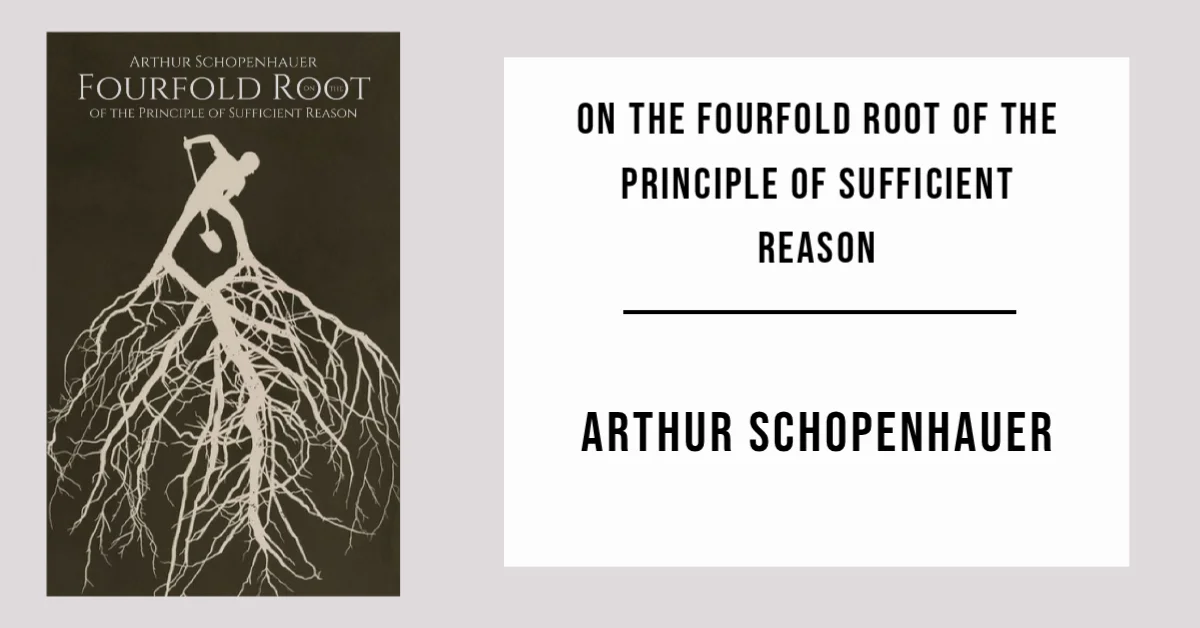
Arthur Schopenhauer wrote On the Fourfold Root of the Principle of Sufficient Reason as his doctoral dissertation in 1813, and it became the philosophical foundation for his entire body of work. In it, he dissects the principle that "nothing is without a reason" into four distinct classes, each governing a different aspect of how we experience reality.
You can now download this essential philosophical text as a free PDF and start exploring Schopenhauer's rigorous analysis of causation, logic, mathematics, and motivation. Few people know this book, but it holds the key to understanding everything Schopenhauer wrote afterward.
Whether you are studying philosophy formally or simply curious about how we make sense of the world, Schopenhauer's clarity and directness make this surprisingly accessible for a work of its depth.
On the Fourfold Root of the Principle of Sufficient Reason by Arthur Schopenhauer
*Please wait a few seconds for the document to load, the time may vary depending on your internet connection. If you prefer, you can download the file by clicking the link below.
Loading PDF...
Information: On the Fourfold Root of the Principle of Sufficient Reason
- Author: Arthur Schopenhauer
- Publication Date: 1813
- Main Characters:
- Principle of Sufficient Reason of Becoming: The law of causality governing changes in the physical world, where every event must have a prior cause
- Principle of Sufficient Reason of Knowing: The logical ground that requires every true judgment to have a reason or proof supporting it
- Principle of Sufficient Reason of Being: The ground of mathematical and spatial relations, explaining why geometric and arithmetic truths hold necessarily
- Principle of Sufficient Reason of Acting: The law of motivation, which explains why conscious beings act based on motives that serve as causes of their actions
- Immanuel Kant: The philosopher Schopenhauer engages with most deeply, building on Kant's distinction between phenomena and noumena while correcting what he sees as Kant's errors
- Brief Summary: On the Fourfold Root of the Principle of Sufficient Reason examines the foundational philosophical idea that nothing exists or occurs without a sufficient reason. Schopenhauer identifies four distinct classes of this principle: the principle of sufficient reason of becoming (causality in the physical world), the principle of sufficient reason of knowing (logical grounding), the principle of sufficient reason of being (mathematical and spatial relations), and the principle of sufficient reason of acting (motivation). He argues that previous philosophers, including Kant, conflated these four forms, leading to confusion. The work systematically demonstrates how each class operates within its own domain of objects and cognitive faculties. It serves as both a standalone philosophical treatise and the essential introduction to Schopenhauer's later masterwork, The World as Will and Representation.
- Thematic Analysis: The central theme is the classification of all human knowledge and experience under four distinct forms of the principle of sufficient reason: causality, logical ground, mathematical necessity, and motivation. Schopenhauer also explores the relationship between subject and object, the limits of human cognition, and the errors that arise when philosophers apply one form of the principle where another belongs. The text engages critically with Kant, Leibniz, Wolff, and other predecessors, making it a focused exercise in philosophical clarification.
- Historical Context: Schopenhauer submitted this work as his doctoral dissertation at the University of Jena in 1813, during the Napoleonic Wars that were reshaping Europe. He substantially revised and expanded the text in 1847, incorporating decades of further reflection and sharpening his critiques of contemporaries like Hegel. The dissertation was written at a time when German Idealism dominated philosophy, and Schopenhauer positioned himself as a corrective voice, insisting on clarity and rigor over what he saw as speculative excess.
Books by Arthur Schopenhauer

Essays Of Schopenhauer by Arthur Schopenhauer

On Women by Arthur Schopenhauer

The Basis Of Morality by Arthur Schopenhauer

The Essays of Arthur Schopenhauer Counsels and Maxims by Arthur Schopenhauer
The Essays of Arthur Schopenhauer Religion a Dialogue Etc by Arthur Schopenhauer
The Essays of Arthur Schopenhauer Studies in Pessimism by Arthur Schopenhauer
The Essays of Arthur Schopenhauer on Human Nature by Arthur Schopenhauer

The Essays of Arthur Schopenhauer the Art of Controversy by Arthur Schopenhauer

The Essays of Arthur Schopenhauer the Art of Literature by Arthur Schopenhauer

The Essays of Arthur Schopenhauer the Wisdom of Life by Arthur Schopenhauer

The World as Will and Idea, Vol. 1 by Arthur Schopenhauer

The World as Will and Idea, Vol. 2 by Arthur Schopenhauer

The World as Will and Idea, Vol. 3 by Arthur Schopenhauer