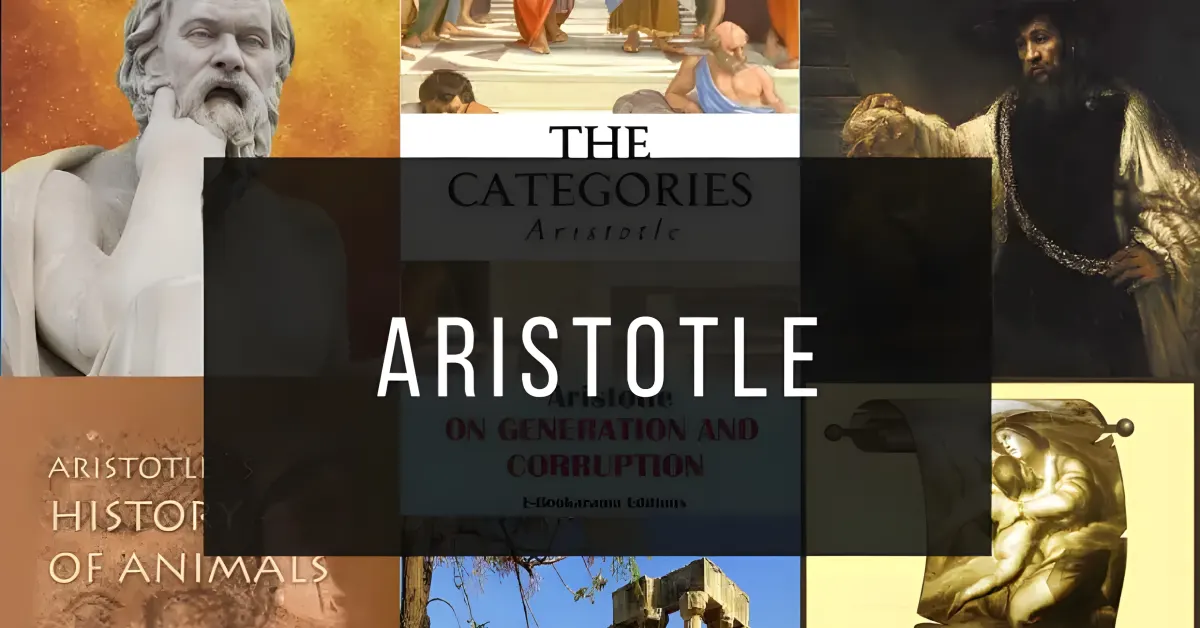
These free Aristotle books collect the work of the Greek philosopher who studied under Plato and tutored Alexander the Great. Aristotle of Stagira founded his own school in Athens, the Lyceum, and taught there for twelve years.
This collection brings together 25 of Aristotle's works in free PDF, grouped the way scholars actually read them. Logic and the Organon, metaphysics, ethics and politics, physics and cosmology, biology, and rhetoric and poetics.
Aristotle's method was to look first and theorize second, and that patient inquiry carried his philosophy across two thousand years. Pick the topic you want to think about and download the complete text for free.
📚
Download every book on this page in one click
Sign in with Google and grab them all without going one by one.
We will redirect you to accounts.google.com to complete sign-in.
Email and name only · We never send spam
Access unlocked
Download every book on this page in one click
Get them all together, without going one by one.
Direct download · One ZIP file
Download started. Check your downloads folder for the ZIP.
Logic
Aristotle Logic Books (The Organon)
The six treatises collected as the Organon are where Aristotle invented formal logic, and nobody improved on the syllogism for two thousand years. Start with Categories for the foundation, or with On Sophistical Refutations if you would rather learn to spot a bad argument.
The complete six treatises of Aristotle's logic gathered in one volume, from the Categories through the Sophistical Refutations. This is the founding text of formal logic and the single best entry point to his method of reasoning.
Aristotle sorts everything that can be said about a thing into ten basic kinds, from substance to relation and quality. It is the shortest door into his system and the foundation the rest of the Organon builds on.
A compact study of how nouns and verbs combine into statements that can be true or false. Aristotle works out negation, opposition and the problem of statements about the future.
The book where the syllogism is invented and worked out in full, figure by figure. Aristotle shows how conclusions follow from premises by form alone, an analysis that stood unchallenged for two thousand years.
Aristotle moves from valid argument to genuine scientific knowledge, asking what makes a demonstration explanatory rather than merely correct. It is his theory of what a science is and how first principles are known.
A working handbook for dialectical argument, stocked with lines of attack and defense for reasoning from widely held opinions. Useful to anyone who debates, not only to logicians.
The first systematic catalogue of fallacies, showing how arguments that look like refutations fail. Read it to learn how bad reasoning is built and how to take it apart.
Metaphysics asks what it means for anything to exist at all, and On the Soul asks what makes a body alive. These are the two hardest and most rewarding free Aristotle books on this page.
Aristotle asks what it means for anything to exist at all, and builds his account of substance, essence, the four causes and the unmoved mover. The Ross translation, and the hardest and most influential book he wrote.
Known as De Anima, this is Aristotle's account of what makes a body alive, treating soul as the form and activity of a living thing rather than a separate substance. It founded the study of perception, imagination and intellect.
For Aristotle, ethics and politics were one subject, because a good life is something you can only live inside a community. The Nicomachean Ethics works out what virtue is, and the Politics works out what kind of city lets people practice it.
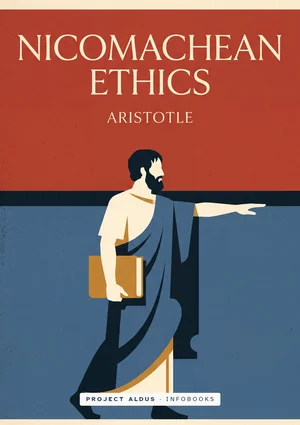
Aristotle's most read work, asking what a good human life is and answering with virtue, the mean between extremes, friendship and practical wisdom. The Ross translation, complete in ten books.
The other complete ethical treatise, covering much of the same ground as the Nicomachean Ethics but with a distinct treatment of happiness, choice and good fortune. Essential for readers who want to see how Aristotle's ethical thinking developed.
A condensed treatment of Aristotle's moral philosophy covering virtue, responsibility and the voluntary in more direct language than the longer Ethics. A useful companion for tracing how his ethical arguments were taught.
Aristotle treats the city as the setting where a good life becomes possible, then compares constitutions, citizenship, revolution and education. The Jowett translation, complete in eight books.
A history of how Athens was actually governed, from its early reforms through the democracy of Aristotle's own day, followed by a description of its offices and courts. It is the most concrete political text in the corpus.
These four books are Aristotle's account of nature: why anything moves, changes, or falls apart. He got the astronomy wrong, but the word physics comes from this book, and so does the habit of asking what causes what.
The book that gave physics its name, working out what nature is and how motion, change, place, time and infinity should be understood. The Hardie and Gaye translation, complete in eight books.
Aristotle's account of the cosmos, the elements and the motion of the celestial bodies. The astronomy did not survive, but the reasoning shaped how the universe was pictured until Copernicus.
A study of everything that happens between the earth and the stars, covering weather, comets, rivers, earthquakes and the sea. It is Aristotle at his most observational about the physical world.
Aristotle spent years watching animals on Lesbos and writing down exactly what he saw, which is why these are the first works of biology anyone wrote. Some of his conclusions did not survive, but his method of careful observation founded a science.
The largest work in the corpus, recording what Aristotle observed about hundreds of species, their anatomy, habits, breeding and behavior. The Thompson translation, and the first work of systematic zoology.
Aristotle asks not just what animal bodies are made of but what each part is for, setting out the method of explaining structure by function. It opens with his defense of studying animals at all.
A detailed study of reproduction and inheritance across species, and Aristotle's most sustained piece of biological theorizing. The Platt translation, complete in five books.
A short treatise on the five senses and how perception actually works, covering color, sound, smell and taste. The opening piece of the Parva Naturalia.
Aristotle links breathing, vital heat and the span of a life into one physiological account of why living things age and die. Short, and unusually direct about the body.
Rhetoric breaks persuasion into ethos, pathos, and logos, and politicians still use all three on you every day. Poetics does the same for storytelling, and screenwriters have been quietly working from it for a century.
Aristotle breaks persuasion into character, emotion and argument, then shows how each is built for a real audience. Still the sharpest analysis of how speech moves people.
The founding text of literary criticism, analysing tragedy into plot, character and catharsis, and arguing that a story works by the shape of its action. Short, and still used by writers today.
Aristotle wrote for students, not for specialists. That plainness is part of why his philosophy survived through Arabic and Latin commentators into the modern world.
All 25 texts here are in the public domain, so read them and share them freely. For more thinkers like him, browse our philosophy books or the full list of classic authors.
Send this page to someone who’d love to read it. Everything is free, no sign-up needed.
Esc
Start typing to search...
Searching...
No results found
Try different search terms
Your book is downloading!
If InfoBooks helped you, you can support us in one click: add us as a preferred source on Google. You'll see more of our books when you search, and you'll help us keep sharing free reading with everyone.
Done! Your book is downloading
Know someone who’d enjoy reading it? Send them this page. It’s free, no sign-up needed, and you help us spread the love of reading.
![19 Free Friedrich Nietzsche Books [PDF]](https://cdn.infobooks.org/images/Friedrich-Nietzsche-Books.webp)