
The Monster Men by Edgar Rice Burroughs [PDF]
by InfoBooks
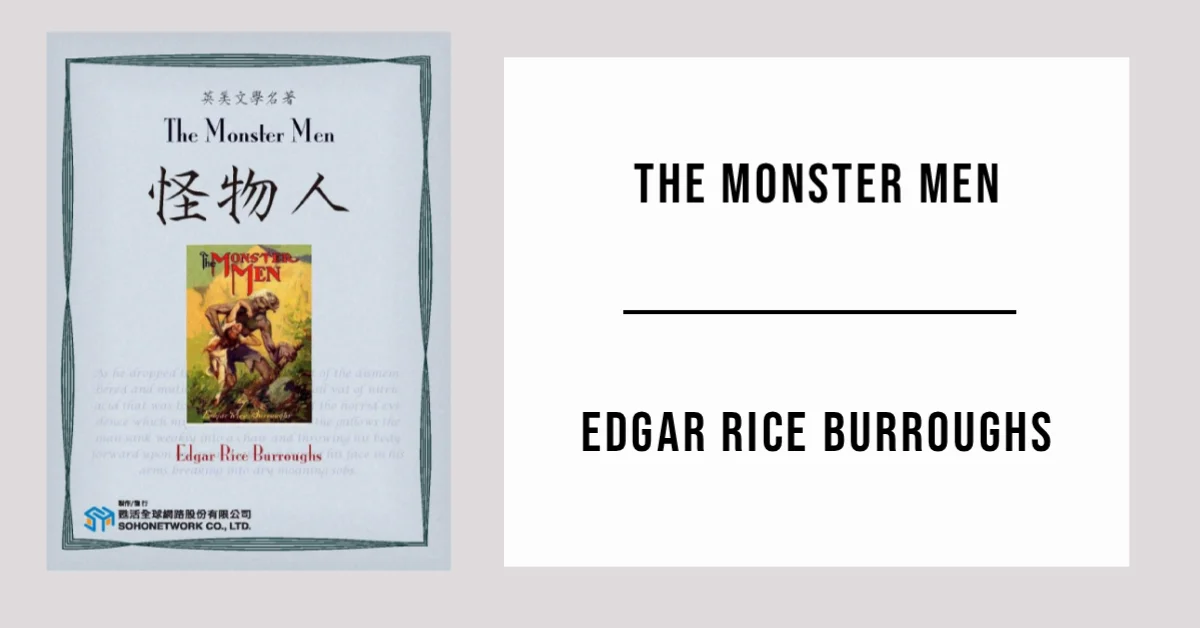
Edgar Rice Burroughs wrote The Monster Men during the same explosive burst of creativity that produced Tarzan and John Carter of Mars. The novel raises unsettling questions about creation, identity, and the ethical limits of science that still resonate today. Set on a fictional island in the Malay Archipelago, the story combines Burroughs' signature pulse-pounding action with a deeper philosophical current about what separates a man from a monster.
The plot centers on Professor Maxon's dangerous obsession with manufacturing human life from raw chemicals. When his experiments spiral out of control and his daughter Virginia is caught between rival factions, only the mysterious Number Thirteen stands between her and destruction. The novel is packed with betrayals, jungle chases, pirate attacks, and a final twist that reframes the entire story.
First published as a serial in All-Story Magazine in November 1913, The Monster Men appeared in book form in 1929 through A.C. McClurg. Burroughs originally titled it "Number Thirteen" before the magazine renamed it. The story reflects early 20th-century anxieties about scientific progress and remains one of the most unique entries in Burroughs' catalog, sitting at the crossroads of pulp adventure and proto-science fiction.
The Monster Men by Edgar Rice Burroughs
*Please wait a few seconds for the document to load, the time may vary depending on your internet connection. If you prefer, you can download the file by clicking the link below.
Loading PDF...
Information: The Monster Men
- Author: Edgar Rice Burroughs
- Publication Date: 1913
- Main Characters:
- Professor Arthur Maxon: A Cornell University scientist consumed by his obsession to create artificial human life. He retreats to a remote island to continue his experiments, endangering both himself and his daughter.
- Virginia Maxon: The professor's brave and resourceful daughter. She becomes the target of multiple kidnapping attempts and must navigate the dangerous web of alliances on the island.
- Number Thirteen (Bulan): The final and most successful of Maxon's creations, outwardly a perfect human man. He takes the name Bulan and risks his life repeatedly to protect Virginia.
- Dr. von Horn: Maxon's treacherous assistant who secretly plots to steal Virginia and her father's wealth. He manipulates both the professor and the monster men for his own gain.
- Sing Lee: A loyal Chinese servant who holds the key secret about Number Thirteen's true identity. His revelation at the climax overturns the central mystery of the story.
- Brief Summary: The Monster Men follows Professor Arthur Maxon, who retreats to a remote island in the East Indies to pursue forbidden experiments in creating artificial life. His thirteenth and final creation, Number Thirteen, emerges as a seemingly perfect human specimen. When the earlier, grotesque experiments escape and Virginia Maxon is kidnapped, Number Thirteen becomes her unlikely protector. The story builds through a web of pirate attacks, jungle pursues, and the schemes of the treacherous assistant von Horn. A dramatic final revelation redefines everything the reader believed about Number Thirteen's true nature.
- Thematic Analysis: The novel explores the ethics of playing god, questioning whether a being's origin determines its worth or humanity. Burroughs contrasts the physical monstrosity of the failed experiments with the moral monstrosity of human characters like von Horn, suggesting that true evil comes from choice, not creation. The romance between Virginia and Bulan tests whether love can exist beyond the boundaries of conventional humanity.
- Historical Context: Written in 1913, The Monster Men appeared during a period of rapid scientific advancement and growing public fascination with genetics and evolution. The story channels anxieties about where science might lead if left unchecked, predating similar themes in works like Huxley's Brave New World by nearly two decades. Burroughs drew on the tradition of Shelley's Frankenstein while transplanting the "mad scientist" concept into the exotic adventure settings that defined his career.