Browse our growing collection of free blacksmithing books in PDF. From beginner training manuals to classic public-domain texts that shaped the craft, every title here is free to read or download.
These books cover forge work, hammer and anvil techniques, wrought ironwork, and heat treatment. Beginners can start with the training manuals; experienced smiths can dig into Practical Blacksmithing or the COSIRA wrought ironwork series.
Pick a title and click download. Each PDF opens in your browser or saves to your device, your choice.
📚
Download every Blacksmithing book on this page
All the books on this page in one ZIP file, instead of downloading them one by one.
We will redirect you to accounts.google.com to complete sign-in.
Email and name only · We never send spam
Access unlocked
Download every Blacksmithing book on this page
All the books on this page in one ZIP file, instead of downloading them one by one.
Direct download · One ZIP file
Download started. Check your downloads folder for the ZIP.
For Beginners
Books on Blacksmithing for Beginners
Start here if you have never held a hammer near a forge. These training manuals walk you through tools, safety, basic strikes, and your first practical projects.
Concise 26-page primer covering history of the craft, shop safety, forge anatomy, fuels, metals, basic tools, and your first project. A clean starting point if you have never lit a forge.
Full course in beginner blacksmithing built around literacy and essential workplace skills. Covers tools, safety, math for measuring, and hands-on forge projects with worksheets and review questions.
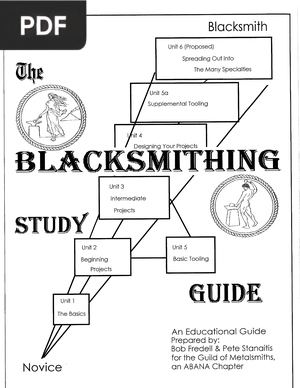
Comprehensive 158-page study guide covering forging fundamentals, projects, tooling, and safety. Image-based scan but the content is thorough and battle-tested in real shop classrooms.
Peace Corps training manual on basic forge techniques, written for instructors who teach blacksmithing in development settings. Practical, illustrated, and free of jargon.
The Farallones Institute Rural Center and CHP International
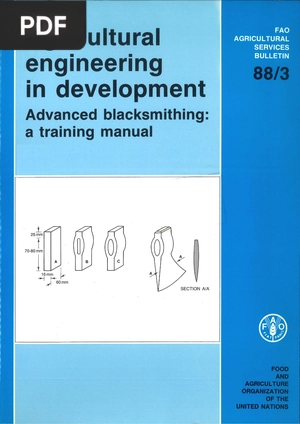
FAO training manual that walks you through forging blacksmith tools, mechanic and carpenter tools, and farm hardware for small-scale rural workshops. Each project builds on the previous one.
Once you know your anvil from your swage block, these texts go deep on hand forging, forge welding, and heat treatment. Most are classic engineering textbooks from 1900-1930, still relevant because the physics has not changed.
Classic 1917 forge textbook written for vocational schools. Walks the student from fire building and tool handling through bending, drawing, upsetting, welding, and tempering. Each exercise includes a working drawing.
Forging textbook from Crane Technical High School in Chicago. Each chapter explains a technique and follows up with a graded exercise, from simple drawing-out to forge welding and tool dressing.
Industrial forging manual covering hand forging, machine forging, heat treatment, and the metallurgy of carbon and alloy steels. Written when forging was still the dominant method of producing tools and small parts.
The deepest treatment of forging and heat treatment in this collection. Covers hand and machine forging, hardening, tempering, annealing, and the testing of finished tools, with extensive drawings and shop exercises.
Where blacksmithing turns into sculpture. The COSIRA series, originally written for British craftspeople in the mid-20th century, is the gold standard for ornamental ironwork: gates, railings, scrolls, and traditional joints.
The foundational five-part COSIRA series on traditional British smithing, combined here into a single volume. Covers the workshop, tools, joints, fire management, and the basic operations every smith returns to.
Council for Small Industries in Rural Areas (COSIRA)
Six-part COSIRA manual on wrought ironwork, merged into one PDF. Detailed instruction on scrolls, leaves, collars, twists, and the assembly methods used to build gates and railings without welding.
Council for Small Industries in Rural Areas (COSIRA)
Two-part COSIRA series focused on ornamental work: panels, leaves, baskets, and finials. The drawings are the main attraction and show how each motif is built up from simple stock.
Council for Small Industries in Rural Areas (COSIRA)
American counterpart to the COSIRA series, written by a Chicago smith. Photographs and drawings show how to build gates, hinges, and decorative panels using only hand tools and the anvil.
A photographic survey of Spanish wrought iron from the Romanesque through the Baroque, with grilles, rejas, lanterns, and altar railings documented in detail. Reference material for anyone working in historical or ecclesiastical traditions.
The original references. Practical Blacksmithing by M.T. Richardson and Modern Blacksmithing by Holmstrom were the working library for generations of smiths. They are old, but they are precise.
Reference book that sat on the workbench of countless American smiths in the early 1900s. Covers general blacksmithing, rational horseshoeing, wagon making, and dozens of tables and recipes useful in the shop.
First volume of the seminal four-volume series compiled from letters and notes by working smiths across the United States in the 1880s. Topics range from forge setup and tool dressing to the small problems that come up in daily shop work.
Second volume of Richardson's series. Continues with horseshoeing, vehicle ironwork, hardening and tempering, and contributions from blacksmiths working in the railroad and farm trades.
Reference written in 1907 by a fourth-generation smith. Detailed instructions on forging, welding, hardening, tempering, casehardening, annealing, coloring, and brazing.
Illustrated reference covering forging operations through worked examples. Strong on practical fixes for chains, hooks, hinges, and the kind of repair work that came through a shop in the early twentieth century.
Pocket reference with tables, formulas, and notes on iron and steel for working smiths. Compact and stripped of theory, useful as a quick lookup at the anvil.
Send this page to someone who’d love to read it. Everything is free, no sign-up needed.
Esc
Start typing to search...
Searching...
No results found
Try different search terms
Your book is downloading!
If InfoBooks helped you, you can support us in one click: add us as a preferred source on Google. You'll see more of our books when you search, and you'll help us keep sharing free reading with everyone.
Done! Your book is downloading
Know someone who’d enjoy reading it? Send them this page. It’s free, no sign-up needed, and you help us spread the love of reading.