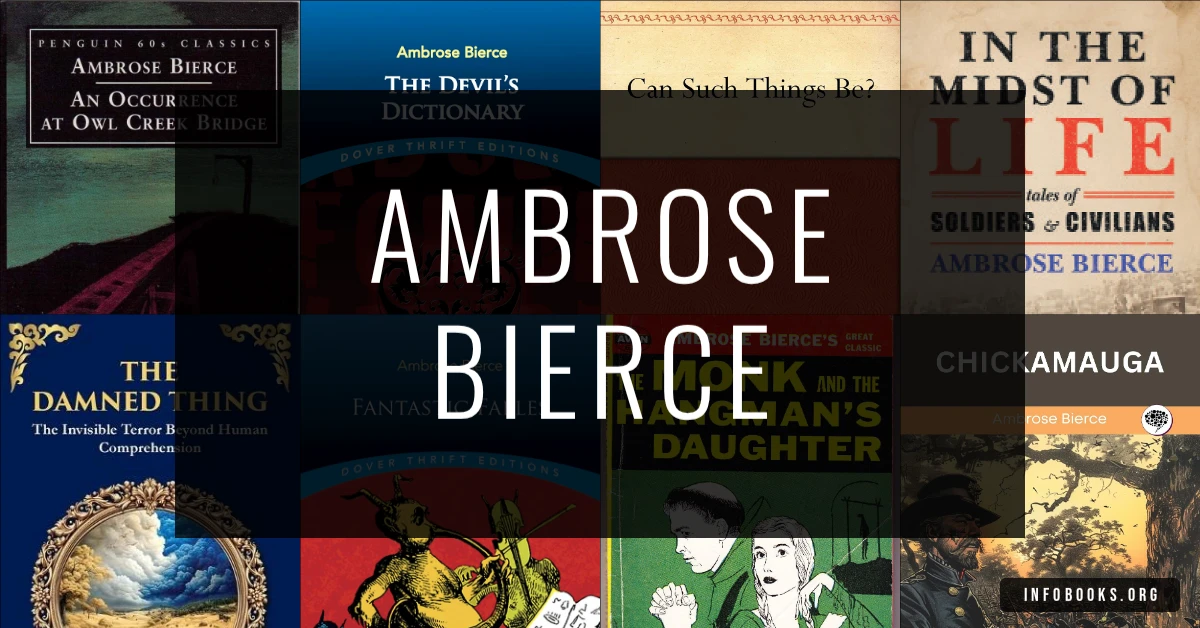
Looking for Ambrose Bierce books? Bierce was an American satirist who fought for the Union in the Civil War and turned what he saw at Shiloh into dark, unforgettable fiction.
Here you'll find An Occurrence at Owl Creek Bridge, The Devil's Dictionary, Can Such Things Be? and 18 more of his books. He wrote most of them as a newspaper columnist in San Francisco, with a sharp style that broke with the Realism of his time.
Every book is free to read online or download as PDF. If you're new to Bierce, start with Owl Creek Bridge, since it takes 20 minutes and you'll read the ending twice.
📚
Download every book on this page in one click
Sign in with Google and grab them all without going one by one.
We will redirect you to accounts.google.com to complete sign-in.
Email and name only · We never send spam
Access unlocked
Download every book on this page in one click
Get them all together, without going one by one.
Direct download · One ZIP file
Download started. Check your downloads folder for the ZIP.
War Stories
Ambrose Bierce Civil War Stories
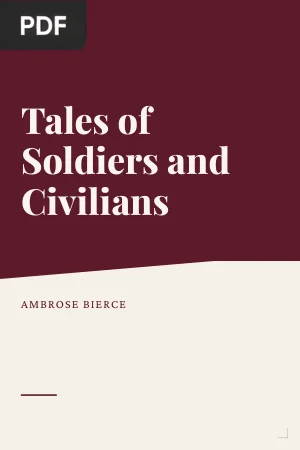
Stephen Crane imagined his war, but Bierce fought at Shiloh and Chickamauga, and his stories show it without a trace of glory. Start with Tales of Soldiers and Civilians, the collection that holds An Occurrence at Owl Creek Bridge.
The collection that holds An Occurrence at Owl Creek Bridge, Chickamauga and A Horseman in the Sky, written by a writer who fought at Shiloh. Its soldier stories show the war without glory, and its civilian tales, like The Boarded Window, turn quietly to horror.
A Confederate planter stands on a railroad bridge with a rope around his neck, and then the rope breaks. Bierce's most famous story takes 20 minutes to read and has one of the great twist endings in fiction.
A small boy wanders into the woods playing soldier and meets a line of wounded men crawling away from the battle. A short, brutal story about one of the bloodiest fights of the Civil War, seen through the eyes of a child.
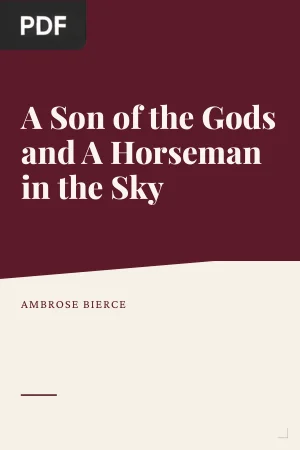
Two of his best war stories in one volume: a young officer who rides alone toward a hidden enemy, and a Union sentry who has to choose between his duty and his father. Includes an introduction by the writer W. C. Morrow.
Bierce's own memories of the war, from What I Saw of Shiloh to A Little of Chickamauga and The Crime at Pickett's Mill. Read it next to his stories and you'll see how much of his fiction he lived first.
Bierce's horror reads like a court report, with calm witnesses and something nobody can explain, like the invisible creature in The Damned Thing. His story An Inhabitant of Carcosa inspired Robert W. Chambers's The King in Yellow, and through him H.P. Lovecraft, so if you like Edgar Allan Poe, start here.
His collection of supernatural tales, with The Damned Thing, The Moonlit Road and An Inhabitant of Carcosa, the story that gave a name to the world of The King in Yellow. Ghosts, doubles and the dead told in a calm, almost legal voice.
A coroner's inquest tries to explain how a man was torn apart by something nobody could see. One of the first invisible monster stories ever written, and a short, perfect introduction to Bierce's horror.
Short ghost stories told like newspaper reports: haunted houses, soldiers who return from the dead, and people who vanish in the middle of a field. Most take five minutes to read and stay with you much longer.
A young monk in the Bavarian Alps falls for the daughter of the town executioner, an outcast everyone avoids. Bierce rewrote this Gothic novella from a German original, and its dark ending is pure Bierce.
Bierce spent decades writing newspaper columns in San Francisco, many for William Randolph Hearst, and The Devil's Dictionary collects the definitions that earned him the name "Bitter Bierce." Fantastic Fables and his early books signed as Dod Grile show that his black humor was there from the start.
Bierce's satirical dictionary, with nearly a thousand definitions like Patience: a minor form of despair, disguised as a virtue. Open it on any page: it reads in short bites and its jokes about politics, money and religion still land.
Hundreds of very short fables where the animals, judges and politicians are all equally greedy. Bierce takes the form of Aesop and turns every moral upside down.
The first book edition of The Devil's Dictionary, published in 1906 and covering the letters A to L. Compare it with the 1911 version to see how Bierce sharpened his definitions.
His first book, published in London in 1873 under the pen name Dod Grile. Short sketches, mock news and dark jokes that show his bitter humor was there from the start.
Satirical fables and tales from 1874, signed as Dod Grile and illustrated with engravings by Dalziel Brothers. Includes the Fables of Zambri, the Parsee, an early sketch of the cruel wit of Fantastic Fables.
Four short tales of black humor, including My Favorite Murder and Oil of Dog, where the narrators describe horrible family crimes as if they were small talk. Bierce at his most shocking and funniest.
Bierce was the most feared critic on the West Coast, and Write It Right lists the writing mistakes he couldn't stand. This section adds his essays, two books of satirical verse and his letters to younger writers, the best way to hear his voice outside the fiction.
Bierce's alphabetical list of the words and phrases he could not stand, with a short, sharp reason for each. A quick read that still helps anyone who wants to write with more precision.
His essays on civilization, politics, law, religion and the death penalty, collected in 1909. Bierce argues against almost everything his readers believed, and does it with wit.
A short selection of his essays on civilization, immortality, the death penalty and the art of talking, closing with a handful of cynical epigrams. A good first taste of Bierce the essayist.
Satirical poems from 1892 aimed at the politicians, preachers and poets of his time. Bierce wanted to preserve his enemies like insects in amber, and he did.
His second book of verse, from 1903, with satirical attacks next to more personal and serious poems. It shows a side of Bierce most readers of his stories never meet.
The letters Bierce wrote to younger writers and friends, with advice on style, opinions on books and glimpses of his private life, up to his last trip to Mexico. Includes a memoir by the poet George Sterling.
In late 1913, at 71, Bierce crossed into Mexico to follow Pancho Villa's revolution and was never seen again. Writers from Lovecraft to Kurt Vonnegut have kept going back to the books he left behind.
Looking for more writers like him? Browse our collection of classic authors and find your next favorite book.
Send this page to someone who’d love to read it. Everything is free, no sign-up needed.
Esc
Start typing to search...
Searching...
No results found
Try different search terms
Your book is downloading!
If InfoBooks helped you, you can support us in one click: add us as a preferred source on Google. You'll see more of our books when you search, and you'll help us keep sharing free reading with everyone.
Done! Your book is downloading
Know someone who’d enjoy reading it? Send them this page. It’s free, no sign-up needed, and you help us spread the love of reading.















![43 Free H. P. Lovecraft Books [PDF]](https://cdn.infobooks.org/images/H-P-Lovecraft-Books.webp)