
On Women by Arthur Schopenhauer [PDF]
by InfoBooks
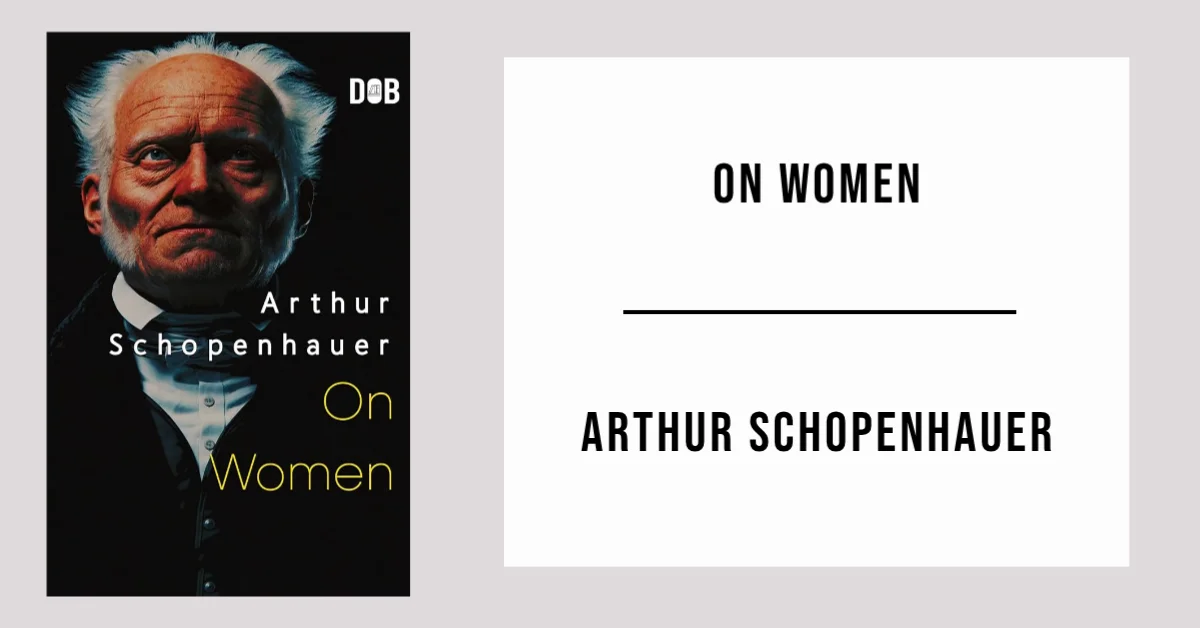
Arthur Schopenhauer's *On Women* is one of the most debated philosophical essays on gender ever written. Published in 1851, it offers a raw, unfiltered window into how one of Germany's greatest thinkers viewed women and their role in society.
Download your free PDF and explore Schopenhauer's controversial arguments firsthand. Reading the original text lets you form your own judgment rather than relying on secondhand summaries.
Sometimes the most valuable books are the ones that challenge us. Dive in and see what Schopenhauer actually said.
On Women by Arthur Schopenhauer
*Please wait a few seconds for the document to load, the time may vary depending on your internet connection. If you prefer, you can download the file by clicking the link below.
Loading PDF...
Information: On Women
- Author: Arthur Schopenhauer
- Publication Date: 1851
- Main Characters:
- The Will: Schopenhauer's central philosophical concept, described as a blind, irrational force driving all human behavior, including relations between the sexes
- Marriage as Institution: Schopenhauer examines monogamy and polygamy across cultures, arguing that marriage laws shape women's social power and economic security
- Nature vs. Civilization: A recurring tension in the essay between what Schopenhauer sees as natural gender roles and the artificial structures imposed by modern European society
- Classical Authorities: Schopenhauer frequently cites ancient Greek and Roman writers, Asian traditions, and Napoleonic legal codes to support his arguments about women's nature
- Aesthetic Judgment: The essay includes Schopenhauer's views on female beauty, connecting physical appearance to his broader theory of aesthetics and the Will's influence on perception
- Brief Summary: In On Women, Schopenhauer argues that women are fundamentally different from men in intellect, temperament, and social function. He draws on examples from ancient and modern cultures to support his claims, weaving in references to classical literature and law. The essay covers topics such as marriage, inheritance, monogamy versus polygamy, and the legal status of women across civilizations. Schopenhauer's tone is deliberately provocative, and his conclusions reflect both his philosophical pessimism and the gender assumptions common in 19th-century Europe. The work is short but dense, packing a wide range of arguments into a few dozen pages.
- Thematic Analysis: The central themes include the nature of gender difference, the social institution of marriage, and the tension between individual desire and societal order. Schopenhauer also explores the idea that nature prioritizes the survival of the species over the happiness of individuals, a theme consistent with his broader philosophy of the Will. The essay touches on aesthetics, law, and cross-cultural comparisons of women's status.
- Historical Context: On Women was published in 1851 as part of Parerga and Paralipomena, a collection of supplementary essays that became Schopenhauer's most commercially successful work. By this time, Schopenhauer was in his sixties and had spent decades in relative obscurity; this collection finally brought him wide recognition. The essay reflects mid-19th-century European attitudes toward gender, predating the major waves of the feminist movement that would challenge many of its assumptions.
Books by Arthur Schopenhauer
Essays Of Schopenhauer by Arthur Schopenhauer
On the Fourfold Root of the Principle of Sufficient Reason by Arthur Schopenhauer

The Basis Of Morality by Arthur Schopenhauer
The Essays of Arthur Schopenhauer Counsels and Maxims by Arthur Schopenhauer
The Essays of Arthur Schopenhauer Religion a Dialogue Etc by Arthur Schopenhauer
The Essays of Arthur Schopenhauer Studies in Pessimism by Arthur Schopenhauer
The Essays of Arthur Schopenhauer on Human Nature by Arthur Schopenhauer
The Essays of Arthur Schopenhauer the Art of Controversy by Arthur Schopenhauer
The Essays of Arthur Schopenhauer the Art of Literature by Arthur Schopenhauer
The Essays of Arthur Schopenhauer the Wisdom of Life by Arthur Schopenhauer
The World as Will and Idea, Vol. 1 by Arthur Schopenhauer
The World as Will and Idea, Vol. 2 by Arthur Schopenhauer

The World as Will and Idea, Vol. 3 by Arthur Schopenhauer