
The Essays of Arthur Schopenhauer on Human Nature by Arthur Schopenhauer [PDF]
by InfoBooks
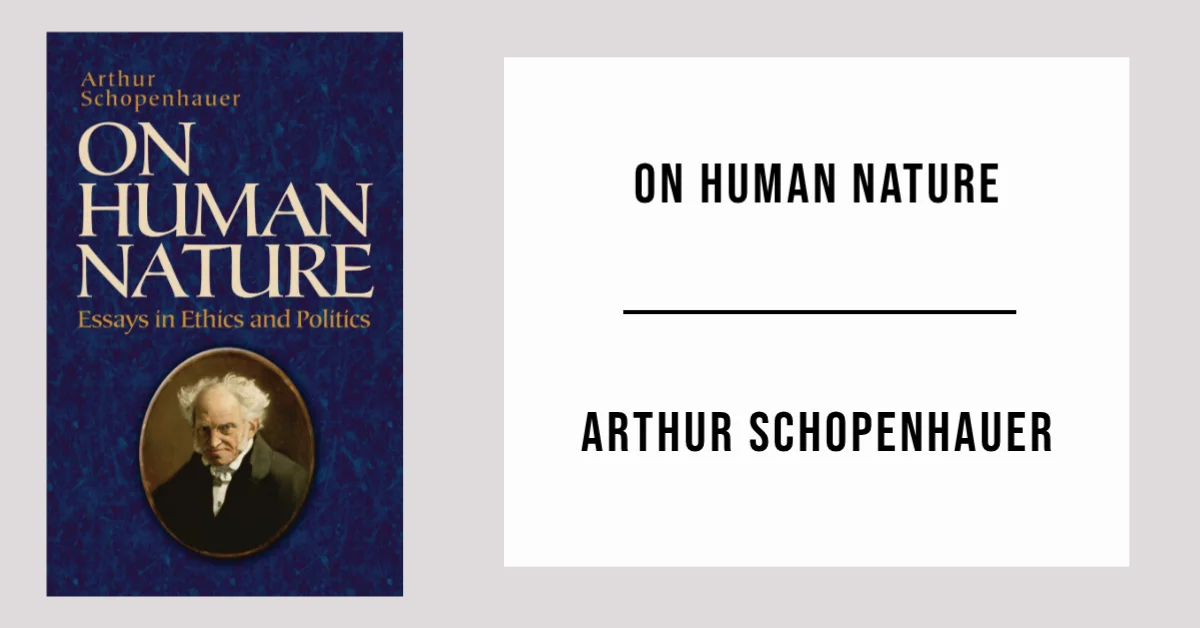
*The Essays of Arthur Schopenhauer on Human Nature* by Arthur Schopenhauer is a collection of philosophical essays exploring the core drives behind human behavior. Schopenhauer strips away social polish to reveal what actually motivates people, from vanity and self-deception to compassion and suffering.
Download this free PDF and get direct access to one of philosophy's sharpest observers of human psychology. These essays cover topics like character, morality, and the will in plain, forceful language that requires no prior background in philosophy.
Originally published in 1897 as part of a translated collection, these essays remain relevant for anyone trying to understand why people behave the way they do. A clear-eyed, no-nonsense read.
The Essays of Arthur Schopenhauer on Human Nature by Arthur Schopenhauer
*Please wait a few seconds for the document to load, the time may vary depending on your internet connection. If you prefer, you can download the file by clicking the link below.
Loading PDF...
Information: The Essays of Arthur Schopenhauer on Human Nature
- Author: Arthur Schopenhauer
- Publication Date: 1897
- Main Characters:
- Arthur Schopenhauer: German philosopher known for his pessimistic worldview and his concept of the Will as the fundamental force behind human behavior and suffering.
- The Will: Schopenhauer's central philosophical concept: a blind, irrational force driving all human action, desire, and conflict beneath the surface of conscious thought.
- Immanuel Kant: Philosopher whose distinction between phenomena and things-in-themselves deeply shaped Schopenhauer's metaphysics and his understanding of human perception.
- Friedrich Nietzsche: Later philosopher who built on and reacted against Schopenhauer's ideas, particularly his pessimism and his elevation of the will as a primary force.
- Brief Summary: This collection gathers Schopenhauer's essays focused specifically on human nature, drawn from his broader philosophical work. He examines topics such as character, the freedom of the will, moral instinct, and the psychological roots of human behavior. The essays are written in a direct, aphoristic style that makes complex ideas feel immediate. The translator, T. Bailey Saunders, preserved Schopenhauer's sharp tone while making the text approachable for English-speaking readers.
- Thematic Analysis: The central themes revolve around determinism, the nature of the will, and the tension between reason and instinct in human conduct. Schopenhauer argues that character is largely fixed and that most of what we call "free choice" is driven by unconscious impulses we barely understand. He also explores moral feeling as something rooted in compassion rather than abstract ethical systems.
- Historical Context: Schopenhauer wrote during the early-to-mid 19th century, a period dominated by Hegelian idealism in German philosophy. His pessimistic, will-centered worldview was a direct challenge to that tradition and would later influence thinkers like Nietzsche, Freud, and Wittgenstein. This English translation, published in 1897, helped bring his ideas to a much wider audience beyond the German-speaking world.
Books by Arthur Schopenhauer
Essays Of Schopenhauer by Arthur Schopenhauer

On Women by Arthur Schopenhauer
On the Fourfold Root of the Principle of Sufficient Reason by Arthur Schopenhauer

The Basis Of Morality by Arthur Schopenhauer

The Essays of Arthur Schopenhauer Counsels and Maxims by Arthur Schopenhauer
The Essays of Arthur Schopenhauer Religion a Dialogue Etc by Arthur Schopenhauer
The Essays of Arthur Schopenhauer Studies in Pessimism by Arthur Schopenhauer
The Essays of Arthur Schopenhauer the Art of Controversy by Arthur Schopenhauer

The Essays of Arthur Schopenhauer the Art of Literature by Arthur Schopenhauer
The Essays of Arthur Schopenhauer the Wisdom of Life by Arthur Schopenhauer
The World as Will and Idea, Vol. 1 by Arthur Schopenhauer

The World as Will and Idea, Vol. 2 by Arthur Schopenhauer

The World as Will and Idea, Vol. 3 by Arthur Schopenhauer