Civil engineering books teach you how a plan on paper becomes a bridge, a road, or a building that lasts a hundred years. Here you will find 25 free titles in PDF format, covering construction, surveying, transportation engineering, building materials and cost estimating.
Every book here comes from a source you can trust. We only list university lecture notes, government agency manuals and open access publications, so you are never downloading a pirated scan.
You will get first year fundamentals, field manuals for site work, and reference material on concrete, highways and building planning. Pick a section, download what you need in one click, or take the whole collection as a single ZIP file.
📚
Download every Civil Engineering book on this page
All the books on this page in one ZIP file, instead of downloading them one by one.
We will redirect you to accounts.google.com to complete sign-in.
Email and name only · We never send spam
Access unlocked
Download every Civil Engineering book on this page
All the books on this page in one ZIP file, instead of downloading them one by one.
Direct download · One ZIP file
Download started. Check your downloads folder for the ZIP.
Beginners
Civil Engineering Books for Beginners
Start here if you are in your first year or coming from another field. These books explain what civil engineering is, what a civil engineer does day to day, and the vocabulary you need before anything else makes sense.
A full first year university course that walks through every branch of civil engineering, from building components and site selection to roads, bridges, dams and water supply. Written as classroom notes, so each concept is introduced from zero with worked diagrams.
A short overview of what civil engineering covers and what a civil engineer actually does day to day. Useful if you are choosing a branch or need the vocabulary before starting a heavier textbook.
Two hundred real questions that come up on site, answered one by one across bridges, concrete, drainage, earthworks, roadworks, piling and foundations. A fast way to fill the gaps between what you studied and what site work demands.
From how a residential structure is put together to how a site stays safe while it is being built. These are the manuals that construction crews and site engineers work from every day.
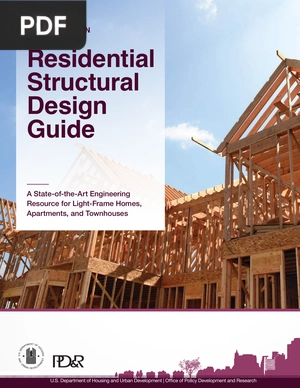
The reference for designing light frame homes, apartments and townhouses, covering loads, foundations, floors, walls, roofs and connections. Every chapter closes with worked design examples you can follow step by step.
The complete field manual for administering a public construction contract, from preconstruction and documentation to materials acceptance, measurement and payment. It is the procedure book that inspectors and project engineers work from every day.
A practical guide to the hazards that cause most construction injuries and how to control them, covering work at height, excavations, plant, electricity and site organisation. Written for anyone responsible for keeping a site safe.
An assessment of offsite and modular construction methods and what they mean for cost, quality and delivery speed. Good background if you want to understand where prefabrication actually pays off.
Research on how digital design models can be used to plan for safe construction before anyone reaches the site. Shows how design decisions made early shape the risks crews face later.
A condensed rundown of the safety requirements that apply most often on construction sites, organised by topic so you can find the rule you need fast. Covers scaffolding, fall protection, excavations, electrical work, cranes and personal protective equipment.
Concrete, steel and cement behave in ways you have to understand before you specify them. These civil engineering books cover material properties, concrete technology and quality control on site.
A full course on the materials that go into a building and how they are put together, covering aggregates, bricks, lime, cement, concrete, steel, timber and masonry construction. Each material is treated with its properties, field tests and quality criteria.
Course notes on stones, bricks, timber, cement, mortar and concrete, followed by the construction techniques that use them: masonry, floors, roofs, plastering and painting. Written for students meeting these materials for the first time.
Covers cement chemistry, aggregates, admixtures, fresh and hardened concrete properties, mix design and testing. The core reference if you need to understand why a concrete mix behaves the way it does.
Goes past the basics into mix design methods, special concretes, durability and non destructive testing. Take this one after you are comfortable with ordinary concrete technology.
Every project starts with knowing exactly where things are. These books cover levelling, theodolite and total station work, GNSS positioning and setting out on site.
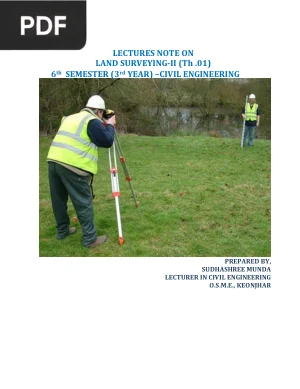
Levelling, contouring, theodolite work, traversing, tacheometry and curve setting out, explained with the field procedures and the arithmetic behind each one. The practical half of a surveying course.
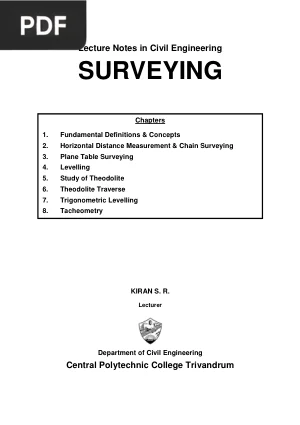
Starts from first definitions and works through chain surveying, plane table work, levelling, the theodolite, traversing, trigonometric levelling and tacheometry. Clear diagrams throughout make it a good first surveying text.
A visual lecture series on surveying types, measurement, levelling and instrument handling, built around photographs of real field equipment. Helpful if you learn better from images than from dense text.
A compact introduction to surveying principles, distance measurement and levelling, laid out as a semester course. Short enough to read in one sitting before you pick up a heavier reference.
Road geometry, pavement design, drainage and traffic flow, straight from the agencies that build and maintain the highway network. One of them is a traffic engineering handbook written for small cities.
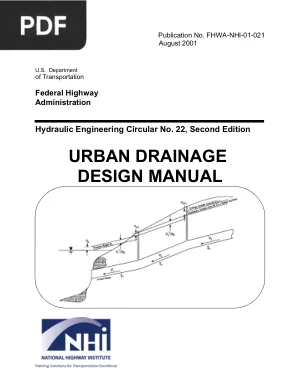
The full method for designing roadway drainage, from rainfall and runoff through gutters, inlets, storm drains, culverts and detention. Dense with design charts, worked examples and the equations behind them.
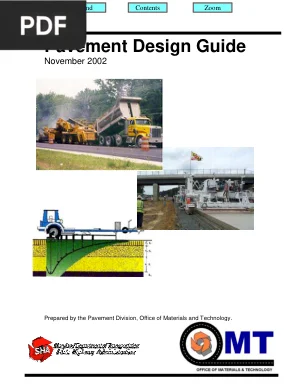
How pavements for new roads and rehabilitation projects are designed, covering traffic loading, subgrade evaluation, flexible and rigid pavement structures and overlay design. Written as the working procedure for a highway agency.
Track components, geometric design, points and crossings, station layouts, then runway orientation, airport planning and terminal design. Covers the two transport modes that rarely appear in general civil engineering texts.
Traffic control devices, signing, speed zoning, parking and intersection treatments, written for engineers working without a large traffic department behind them. Practical answers rather than theory.
Knowing how to build is half the job. These books cover project planning, contracts, cost estimating and risk, which is where most projects are won or lost.
An industry wide look at why construction productivity has stalled and which technologies and management changes could move it. Useful context for anyone thinking about where the sector is heading.
An open textbook covering project delivery methods, contracts, scheduling, estimating, safety and closeout across the full life of a construction project. Structured as a course, with each chapter building on the last.
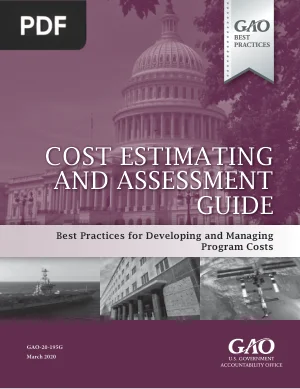
The twelve step method for building a cost estimate that holds up, covering work breakdown structures, data collection, risk and uncertainty analysis and how estimates get audited. Rigorous and applicable well beyond construction.
Measurement of materials and works, types of estimates, detailed and abstract estimates for buildings, rate analysis and valuation. The subject that decides whether a project is priced right before it starts.
If InfoBooks helped you, you can support us in one click: add us as a preferred source on Google. You'll see more of our books when you search, and you'll help us keep sharing free reading with everyone.