Looking for sacred geometry books? We've gathered free sacred geometry books in PDF, covering the Flower of Life, sacred symbols, the Platonic solids, the golden ratio, and geometry in temple architecture.
These books all follow one old idea: that number, ratio, and shape are the language the world is built in. From Euclid and Luca Pacioli to the philosophers who read the cosmos as a set of proportions, they connect compass and straightedge work to myth, ornament, and the patterns in nature.
Browse by topic or start with the general collection. Every book is free to read online or download as PDF.
📚
Download every book on this page in one click
Sign in with Google and grab them all without going one by one.
We will redirect you to accounts.google.com to complete sign-in.
Email and name only · We never send spam
Access unlocked
Download every book on this page in one click
Get them all together, without going one by one.
Direct download · One ZIP file
Download started. Check your downloads folder for the ZIP.
Start Here
Sacred Geometry Books
Start here if the subject is new to you. These are the wide introductions, the ones that set out the vocabulary of circles, triangles, ratios, and solids before going anywhere mystical.
Stirling traces one geometric scheme, a system of proportions he calls the canon, through Egyptian temples, Greek statuary, Gothic cathedrals and the Kabbalah. Dense and eccentric, and still one of the founding texts of the whole subject.
Seven essays by an architect who read buildings as geometry. Bragdon works through symmetry, polarity and what he calls latent geometry, then applies it to the human body and to music.
A painter and a mathematician measure shells, leaves, wasp nests and Renaissance facades looking for the same proportional rules. Hundreds of diagrams, and the clearest case anyone made for geometry as nature's grammar.
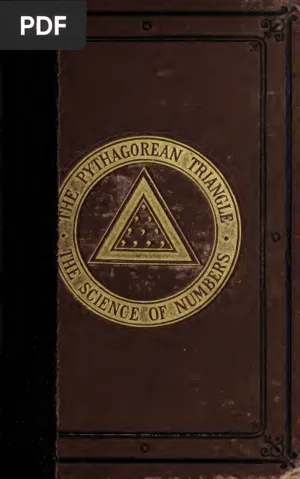
Oliver takes the Pythagorean triangle apart number by number, from the monad and the point up through the decad. A Victorian look at how geometry and number carried meaning in the mystery traditions.
Cook presents B. W. Betts's attempt to draw the growth of consciousness as a series of geometric figures. Strange, rigorous and beautifully diagrammed, with a chapter on the fourth dimension.
The Flower of Life is the pattern most people meet first, overlapping circles carved into temple walls from Egypt to China. These books follow that pattern and its relatives, the Seed of Life and the vesica piscis, through the cultures that kept drawing them.
Jones gathered ornament from Egyptian, Greek, Arabian, Moresque, Celtic and Renaissance sources and set the patterns side by side. The plates show how the same geometric grids resurface in cultures that never met.
Kerrich applies the two overlapping circles of the vesica piscis to the floor plans of churches from Rome to Bath and shows how closely they fit. A short, focused study on the pattern that starts the Flower of Life.
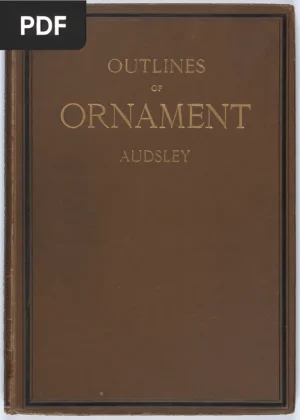
Groups ornament by motive rather than by nation, so you can see the same rosette or interlace worked out by Greek, Moorish, Gothic and Japanese hands. Line drawings throughout, made for study rather than display.
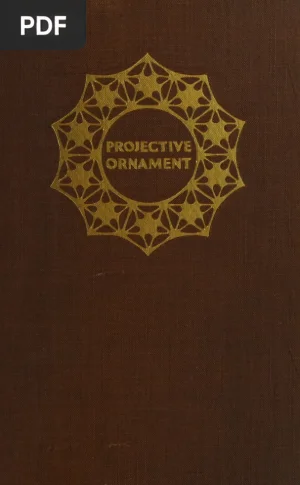
Bragdon builds a whole ornamental language out of magic squares, regular polyhedra and projections from four-dimensional space. A practical manual for generating patterns from geometry alone.
Every figure in this tradition carries a meaning attached to it: the pentagram, the spiral, the triquetra, Metatron's cube. These work as reference books for sacred geometry symbols and meanings, useful when you want to know what a shape meant to the people who drew it.
A designer's collection of several hundred signs used across the ancient world and the Middle Ages, each drawn in clean woodcut form with a short note on what it meant. The reference to reach for when you need a shape identified.
Follows the swastika, the winged globe, the trident and the tree of life as they travel between cultures. Shows how a geometric sign keeps its form while its meaning shifts.
A guide to the symbols painters used and the stories behind them, from the circle and the triangle to the attributes that identify each saint. Written for people who want to read a picture rather than just look at it.
Five solids, and only five, can be built from identical regular faces, and Plato tied them to fire, earth, air, water, and the shape of the cosmos. These books cover the Platonic solids and the Archimedean forms that follow them, some with fold-up patterns you can print and build.
Builds squares, pentagons, conic sections and regular polyhedra using nothing but folded paper. The exercises make the constructions physical, which is why the book keeps getting reprinted.
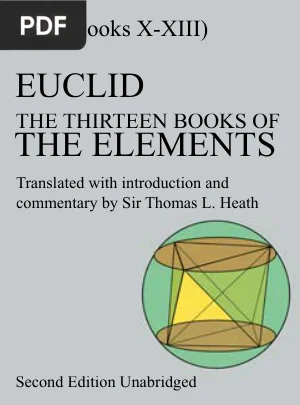
Books X to XIII in Heath's translation, ending with the construction of the five Platonic solids and the proof that there are no others. Heath's commentary explains every step and its history.
Bragdon uses analogy and a set of striking plates to explain what a fourth spatial dimension would mean, and what regular solids become when you push them one dimension up.
Ball's classic gathering of puzzles, constructions and mathematical curiosities, with chapters on polyhedra, magic squares, the geometry of chessboards and the history of squaring the circle.
One number, roughly 1.618, keeps turning up in pentagons, spirals, and the proportions of old buildings, and Luca Pacioli called it the divine proportion. These books look at the golden ratio without the hype, separating what the arithmetic actually shows from what gets claimed about it.
Hambidge's lesson course on root rectangles and the whirling square, the system he built around the golden section. Step by step, with the constructions drawn out.
Hambidge measures Greek pottery and argues the shapes follow root-two and golden section rectangles. Whether or not you accept the conclusion, the analysis is careful and fully illustrated.
The sequel to Nature's Harmonic Unity, working through spirals, ellipses, catenary curves and the golden series in nature, art and architecture. Heavy on diagrams and measurement.
Cook tracks the spiral through shells, horns, plants, staircases and Leonardo's notebooks. Over four hundred illustrations, and an unusually level-headed discussion of where the phi claims hold and where they do not.
Builders used geometry long before they used blueprints, laying out pyramids, cathedrals, and mosques with compass work and simple ratios. These books read buildings as geometry, from classical treatises on proportion to studies of Gothic tracery and Islamic pattern.
The oldest surviving treatise on architecture, in Morgan's translation. Vitruvius sets out the ratios for temples and derives them from the proportions of the human body, the passage that later produced Vitruvian Man.
Lethaby reads buildings as cosmology: the dome as sky, the pavement as earth, the four squares of the plan as the four quarters. An architect explaining why sacred buildings keep repeating the same geometry.
Hankin reverse engineers Islamic star patterns and shows the hidden construction lines that generate them. Once you see the method, the patterns stop looking impossible to draw.
Hambidge applies his dynamic symmetry analysis to temple plans and elevations, arguing the Greeks laid them out with root rectangles. Detailed measured drawings throughout.
Sacred geometry sits between mathematics and belief, and these books let you decide where the line falls. Some are careful historical studies, others are frankly speculative, and both are worth reading with that in mind.
Every one is free to download, with no account needed. For more on symbols, numbers, and the traditions built around them, browse our Esoteric Books collection.
Send this page to someone who’d love to read it. Everything is free, no sign-up needed.
Esc
Start typing to search...
Searching...
No results found
Try different search terms
Your book is downloading!
If InfoBooks helped you, you can support us in one click: add us as a preferred source on Google. You'll see more of our books when you search, and you'll help us keep sharing free reading with everyone.
Done! Your book is downloading
Know someone who’d enjoy reading it? Send them this page. It’s free, no sign-up needed, and you help us spread the love of reading.