Looking for earthquake books that explain what happens beneath your feet? This collection covers seismology from the basics of faults and seismic waves to tsunamis, plate tectonics, earthquake engineering and seismic interpretation.
Seismology is the branch of geophysics that reads the Earth's interior through the waves earthquakes send around the planet. Here you'll find a classic of the field by John Milne, open lecture notes on body waves and the U.S. Geological Survey's own story of plate tectonics.
Every book is free to read online or download as PDF, with no sign-up. Pick a section below and start with the question that brought you here.
📚
Download every book on this page in one click
Sign in with Google and grab them all without going one by one.
We will redirect you to accounts.google.com to complete sign-in.
Email and name only · We never send spam
Access unlocked
Download every book on this page in one click
Get them all together, without going one by one.
Direct download · One ZIP file
Download started. Check your downloads folder for the ZIP.
Earthquakes
Earthquake Books
Start here if you want to understand why the ground shakes and how scientists measure it. These earthquake books explain faults, magnitude and intensity in clear language, with plenty of maps and diagrams.
A leading earthquake geologist explains faults, plate boundaries, magnitude and the threat of a great Cascadia quake, then shows how to prepare your home and community. Written for general readers, with maps, photos and real case studies.
A richly illustrated handbook on why earthquakes strike the central United States, what the New Madrid Seismic Zone is and the seven steps to stay safe before, during and after a quake.
Ten short, clear articles on how earthquakes happen, how seismographs record them, how scientists find the epicenter and why some places shake harder than others. A great first read for students and families.
The classic by the father of modern seismology, who studied quakes in Japan in the 1880s. Milne covers what earthquakes are, how to measure them, their causes and the slow tremors and pulsations of the ground.
A 1904 classic that brought the new science of seismology to general readers: how earthquake waves travel, how the first seismographs worked and what great quakes like Charleston 1886 revealed about the Earth.
Ready to go deeper? These seismology textbooks and lecture notes cover the wave equation, body and surface waves, and how seismographs record ground motion.
Lecture notes by the author of one of the most used seismology textbooks. They derive the seismic wave equation and explain P and S waves step by step, a solid start for any first course.
The core chapter of the IASPEI manual used in seismic observatories worldwide. It covers body and surface waves, seismic phases, travel times and global Earth models, with clear figures and real seismograms.
A graduate-level classic on how seismic waves travel through layered Earth models, from reflection and transmission to complete synthetic seismograms. Ideal if you want the full mathematical picture.
Milne's own textbook from 1898, written as seismographs began to record quakes from across the globe. It explains the instruments, how vibrations travel through the Earth and what the records reveal.
Most tsunamis start with an undersea earthquake, which is why they belong on this shelf. These tsunami books show how the waves form, cross entire oceans and reach the coast, and how warning systems track them.
Real survivor stories from the 1960 Chilean tsunami turned into practical lessons: heed natural warnings, head for high ground and expect more than one wave. Short, illustrated and easy to remember.
A scientific detective story: how Japanese records of a tsunami with no known source led researchers to a giant Cascadia earthquake in 1700. Beautifully illustrated with historical documents and field evidence.
The official reference of tsunami terms, from run-up and inundation to warning center vocabulary, with diagrams, photos and a list of major historical tsunamis.
Earthquakes cluster along plate boundaries, and these books show you why. Plate tectonics ties mountain building, volcanoes and seismic zones into a single theory of how the Earth works.
The USGS classic on plate tectonics: how the theory was developed, how plates move, and how they cause earthquakes, volcanoes and mountains. A short, well-illustrated read that is perfect as a first approach.
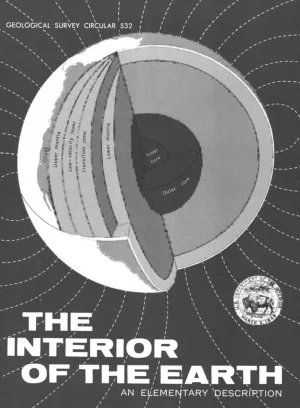
A short USGS booklet on what lies beneath the crust: the mantle, the core and how earthquake waves let us map layers no one can reach. A quick, clear primer on the planet that drives the plates.
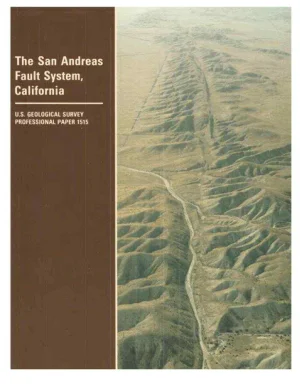
The definitive USGS volume on the San Andreas, the plate boundary between the Pacific and North American plates. It covers its geology, its earthquakes, how fast it slips and what it means for California.
A Penn State course built around real scientific debates: why continental drift took decades to be accepted, whether the New Madrid zone can produce a big quake and if the Atlantic needs a tsunami warning system.
Knowing where the ground will shake is only half the job. These earthquake engineering books cover seismic hazard, building codes and how structures survive strong ground motion.
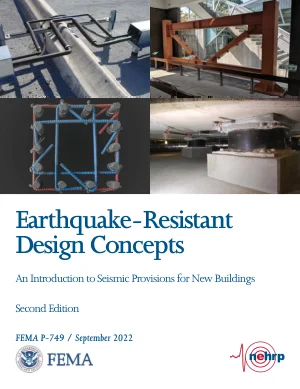
FEMA's plain-language introduction to how building codes protect against earthquakes: ground motion, seismic hazard maps, structural systems and why buildings fail. Part A works for any reader, Part B for engineers.
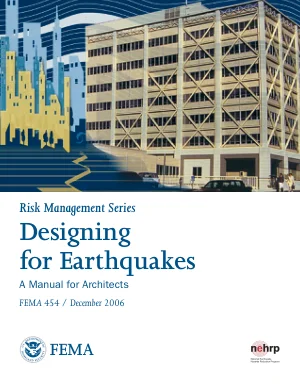
A complete manual on seismic design for architects, from the nature of earthquakes and site effects to building configuration, nonstructural damage and retrofitting existing buildings.
Recent research on how buildings respond to earthquakes, with studies on seismic analysis methods, damping devices, retrofitting and the performance of steel and concrete structures.
Studies on how to assess earthquake damage, design safer buildings and strengthen existing ones, drawing on lessons from recent quakes around the world.
Seismic waves also map what lies underground, from oil reservoirs to buried faults. These seismic interpretation books teach you how reflection data becomes an image of the subsurface.
Claerbout's classic on seismic migration, the method that turns raw reflection data into a picture of the subsurface. It explains wave extrapolation and imaging with clear diagrams and examples.
The signal processing behind every seismic image: convolution, spectra, filtering, deconvolution and velocity analysis, explained with Claerbout's trademark clarity and plenty of figures from real data.
A hands-on textbook on building images from imperfect geophysical data, with worked examples like flattening 3D seismic data, filling gaps and removing noise. Practical and full of insight.
Seismology turns every tremor into data about the planet we live on. Whether you're a student, a teacher or just curious after feeling the ground move, these books give you a solid place to start.
Want to keep exploring? Browse our full collection of physics books for waves, mechanics, electromagnetism and more.
Send this page to someone who’d love to read it. Everything is free, no sign-up needed.
Esc
Start typing to search...
Searching...
We couldn't find anything
Your book is downloading!
If InfoBooks helped you, you can support us in one click: add us as a preferred source on Google. You'll see more of our books when you search, and you'll help us keep sharing free reading with everyone.
Done! Your book is downloading
Know someone who’d enjoy reading it? Send them this page. It’s free, no sign-up needed, and you help us spread the love of reading.