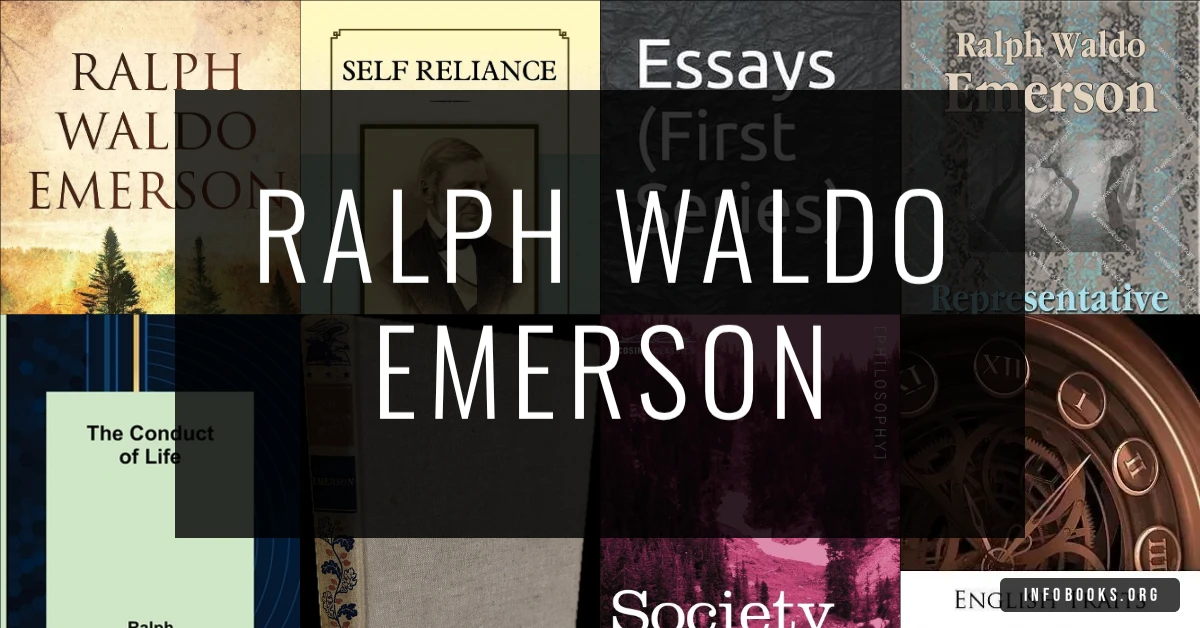
Looking for Ralph Waldo Emerson books? Ralph Waldo Emerson (1803-1882) was the essayist, poet and philosopher from Boston who led American Transcendentalism from his home in Concord.
Here you'll find 20 of his books, from Nature and Self-Reliance to his lectures, poems and journals. His circle included Henry David Thoreau, and his call to trust your own mind still shapes how Americans think about independence.
Every book is free to read online or download as PDF. Start with the essays if you want the Emerson everyone quotes.
📚
Download every book on this page in one click
Sign in with Google and grab them all without going one by one.
We will redirect you to accounts.google.com to complete sign-in.
Email and name only · We never send spam
Access unlocked
Download every book on this page in one click
Get them all together, without going one by one.
Direct download · One ZIP file
Download started. Check your downloads folder for the ZIP.
Essays
Ralph Waldo Emerson Essays
The essays are the heart of Ralph Waldo Emerson's work. Nature (1836) launched Transcendentalism, and Essays: First Series (1841) gave us Self-Reliance.
The little book from 1836 that launched American Transcendentalism. Emerson argues that nature is a language of the spirit and that anyone can meet the universe directly, without leaning on tradition.
Emerson's most quoted essay, from 1841. Trust yourself, ignore conformity and say what you think today, even if it contradicts what you said yesterday. You can read it in under an hour.
Both series of Emerson's essays in a single volume, from History and Self-Reliance to Experience and The Poet. The complete core of his thought in a clean, easy-to-read edition.
The 1841 collection that made Emerson famous, with twelve essays including Self-Reliance, Compensation, The Over-Soul and Circles. Each one opens with a short poem of his own.
Published in 1844, these essays are more personal and searching. Experience, written after the death of his young son, sits beside The Poet, Character, Manners, Gifts and Politics.
Emerson's essay on the hidden balance of life: every gain has its cost and every loss brings something back. This is the 1904 Roycrofters edition, with its engraving of the Old Manse in Concord.
Emerson made his living on the lecture circuit, and most of his later books began as talks. The American Scholar, delivered at Harvard in 1837, was called America's intellectual declaration of independence.
Nature together with his landmark talks, including The American Scholar (1837), the Harvard speech hailed as America's intellectual declaration of independence, and the Divinity School Address that shocked Boston.
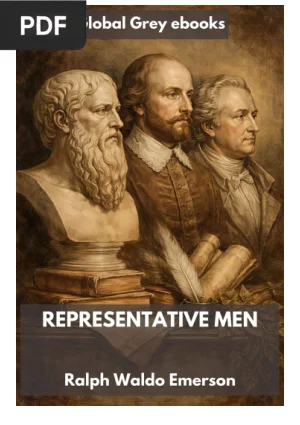
Seven lectures from 1850 on the figures Emerson saw as models of humanity: Plato, Swedenborg, Montaigne, Shakespeare, Napoleon and Goethe. He asks what each of them can teach the rest of us.
Emerson's portrait of the English, drawn from his trips to Britain in 1833 and 1847. He writes about their character, wealth, universities and religion, and about his visits to Carlyle, Coleridge and Wordsworth.
Emerson's most practical book, from 1860. Nine essays on fate, power, wealth, culture and beauty that turn his philosophy into advice on how to live well.
Essays from 1875 on poetry and imagination, eloquence, the comic, quotation and originality, and immortality. One of the last books published in his lifetime.
Lectures on character, education and the scholar, together with portraits of people Emerson knew, including his famous eulogy for Henry David Thoreau and a sketch of Carlyle.
The Household Edition of Emerson's poetry, with Concord Hymn, The Rhodora, Each and All, Brahma and Days. It gathers his two books of verse and opens with a short biographical sketch.
His second book of poems, from 1867. Besides the long title poem it gathers Brahma, Days, Terminus and the Boston Hymn, some of the finest verse he wrote.
Emerson kept journals for more than fifty years, and they work as a laboratory for his essays. His letters with Thomas Carlyle record one of the great literary friendships of the 19th century.
The best of the journals Emerson kept for more than fifty years, selected by Bliss Perry in 1926. A one-volume path into his private thoughts, from his student days to old age.
Volume III of the journals, covering Emerson's first trip to Europe. His notes from Italy, Paris and England, his first meeting with Carlyle and the ideas that became Nature.
The first volume of the letters Emerson and Thomas Carlyle exchanged from 1834. A record of one of the great literary friendships of the 19th century, full of books, publishing and ideas.
The second volume of the Carlyle and Emerson letters, from 1842 to 1872. It follows the two friends through fame, Emerson's second visit to England and old age.
Few writers have shaped American thought as deeply as Ralph Waldo Emerson. If he sparked your curiosity, Thoreau, Walt Whitman and Nathaniel Hawthorne are the natural next step.
Send this page to someone who’d love to read it. Everything is free, no sign-up needed.
Esc
Start typing to search...
Searching...
No results found
Try different search terms
Your book is downloading!
If InfoBooks helped you, you can support us in one click: add us as a preferred source on Google. You'll see more of our books when you search, and you'll help us keep sharing free reading with everyone.
Done! Your book is downloading
Know someone who’d enjoy reading it? Send them this page. It’s free, no sign-up needed, and you help us spread the love of reading.