
Bouvard and Pecuchet by Gustave Flaubert [PDF]
by InfoBooks
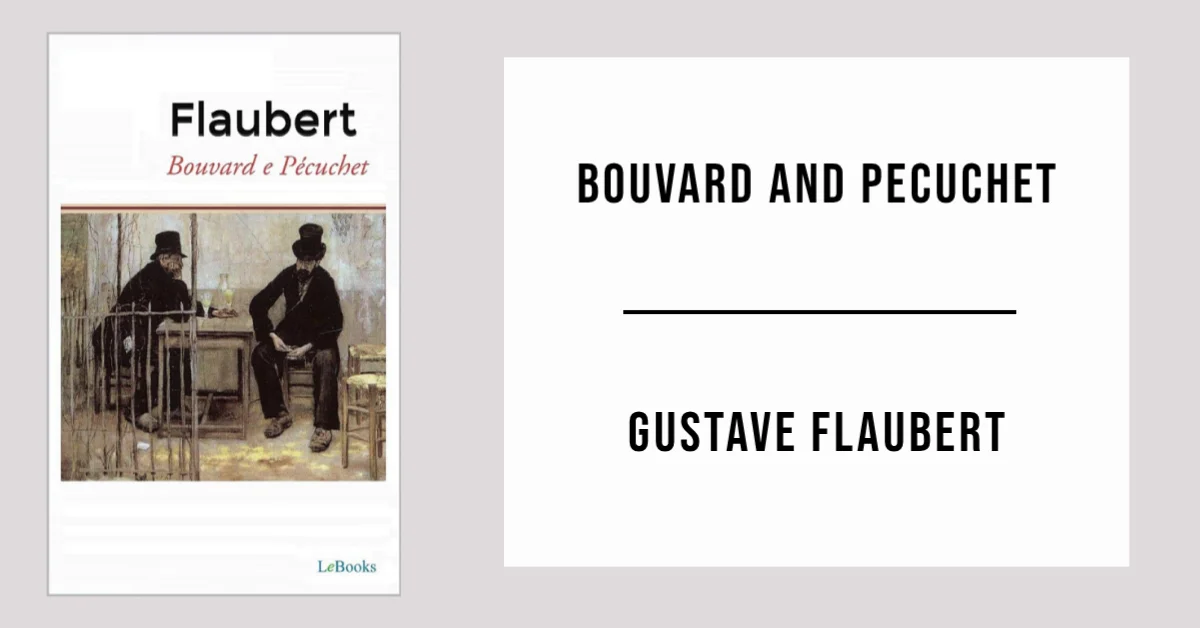
Gustave Flaubert's Bouvard and Pecuchet is a brilliantly funny novel about two well-meaning clerks who attempt to master every field of knowledge and fail at all of them. Published posthumously in 1881, it represents Flaubert's most ambitious and daring literary experiment. The interesting thing about this author is that he devoted the last decade of his life to this single project, reading over 1,500 volumes to fuel its biting satire.
You can now download this free PDF and discover why scholars and readers continue to return to this extraordinary comic novel. Bouvard and Pecuchet offers a surprisingly accessible entry point into Flaubert's genius, combining slapstick humor with profound philosophical commentary. Few people know this book, but those who do consider it among the most original novels ever written.
Ideal for readers who enjoy intellectual humor, literary satire, or the works of authors like Voltaire and Cervantes. If you liked Don Quixote, try Bouvard and Pecuchet: both feature well-intentioned protagonists whose grand ambitions collide hilariously with reality. It is a novel that rewards curiosity and makes you laugh at the same time.
Bouvard and Pecuchet by Gustave Flaubert
*Please wait a few seconds for the document to load, the time may vary depending on your internet connection. If you prefer, you can download the file by clicking the link below.
Loading PDF...
Information: Bouvard and Pecuchet
- Author: Gustave Flaubert
- Publication Date: 1881
- Main Characters:
- Bouvard: A jovial, round-faced copy clerk who inherits a fortune and moves to the countryside to pursue intellectual ambitions with boundless optimism.
- Pécuchet: A thin, methodical copy clerk and Bouvard's inseparable companion, whose earnest dedication to study never translates into practical success.
- Madame Bordin: A wealthy widow and neighbor who becomes a romantic interest for Bouvard, representing provincial bourgeois society.
- Mélie: The housekeeper who serves Bouvard and Pécuchet and witnesses their many failed experiments with bemused patience.
- Victor and Victorine: Two orphaned children whom Bouvard and Pécuchet adopt and attempt to educate, with predictably disastrous results.
- Brief Summary: Bouvard and Pecuchet tells the story of two Parisian copy clerks who inherit a fortune and retire to the Norman countryside to educate themselves in every branch of knowledge. They attempt agriculture, chemistry, medicine, geology, archaeology, literature, politics, philosophy, religion, and education, failing comically in each pursuit. The novel satirizes the superficial acquisition of knowledge and the blind faith people place in experts and textbooks. Flaubert left it unfinished at his death in 1880, and it was published posthumously in 1881. It remains one of the most original and prescient satires in Western literature.
- Thematic Analysis: The central theme is the futility of encyclopedic knowledge when divorced from genuine understanding and practical wisdom. Flaubert also explores the tension between bourgeois ambition and intellectual mediocrity, the unreliability of received ideas, and the comedy inherent in human self-deception. The novel can be read as a critique of positivism and the nineteenth-century belief that science and reason could solve all problems.
- Historical Context: Written during the latter half of the nineteenth century, Bouvard and Pecuchet reflects the era's explosion of popular science, self-help manuals, and encyclopedic ambition in France. Flaubert began the novel in 1872 and worked on it obsessively until his death in 1880, consulting over 1,500 sources. The book appeared in a period when universal education and democratic access to knowledge were reshaping French society, making its satire particularly pointed.
Books by Gustave Flaubert

A Simple Soul by Gustave Flaubert

Herodias by Gustave Flaubert

Madame Bovary by Gustave Flaubert

Over Strand and Field by Gustave Flaubert

Salammbo by Gustave Flaubert

Sentimental Education by Gustave Flaubert

The George Sand by Gustave Flaubert
The Temptation os St Antony by Gustave Flaubert
Three Short Works by Gustave Flaubert