The Enneagram maps nine personality types, each one built on a different core motivation, fear, and desire. These free books walk you through all nine, from the Reformer to the Peacemaker.
The collection covers the whole system, not just the surface. You get type descriptions with their wings and instinctual subtypes, the three centers of intelligence, self-typing tests, and the history behind the symbol.
Reading about your type is where self-awareness starts, and these authors take it further into real change. Every book downloads free, with no registration and no limits.
📚
Download every Enneagram book on this page
All the books on this page in one ZIP file, instead of downloading them one by one.
We will redirect you to accounts.google.com to complete sign-in.
Email and name only · We never send spam
Access unlocked
Download every Enneagram book on this page
All the books on this page in one ZIP file, instead of downloading them one by one.
Direct download · One ZIP file
Download started. Check your downloads folder for the ZIP.
Start Here
Enneagram Books
Start here if the Enneagram is new to you. These books introduce the nine types and the logic behind the system before you go deeper.
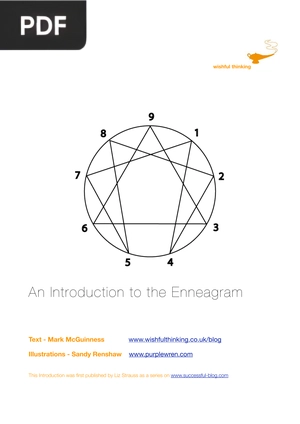
A short illustrated introduction that walks through all nine types grouped by the heart, head, and body centers. Each type gets its own profile, followed by practical advice on observing your own patterns and relating to other types at work and at home.
A visual primer built around one idea: the Enneagram explains why you act, not just what you do. Covers core motivations, core fears, and the most common beginner questions in a clean layout that is easy to scan.
A workbook of exercises for readers who already know their type and want to do something with it. The activities build self-awareness, self-responsibility, and self-mastery, with space to write directly in the pages.
Each type has its own motivation, fear, and path to growth. These type descriptions cover the Reformer, Helper, Achiever, Individualist, Investigator, Loyalist, Enthusiast, Challenger, and Peacemaker, along with their wings and instinctual subtypes.
Research showing that people use one type from each center of intelligence, head, heart, and gut, in a preferred order. Introduces the Tritype model and explains how the three types combine into a single archetype and a shared blind spot.
A depth psychology study that reads the nine types as archetypes. Focus groups with types Three, Six, and Nine surfaced the images, symbols, and metaphors each type uses to describe itself, along with the artwork that came out of the sessions.
A corrective for the common mistake of turning the Enneagram into a labeling game. Explains why typing yourself and others goes wrong, and what to pay attention to instead when a type is hard to pin down.
Connects the three centers and their emotions of fear, anger, and sadness to current thinking in neurobiology and emotion regulation. Proposes that each type is built around a distinct pattern of regulating innate mammalian systems.
Finding your type takes more than one quiz. These questionnaires and assessments help you narrow it down, and the research here shows what a test result can and cannot tell you.
A self-scoring questionnaire that works through nine blocks of statements, one per type. Rate how well each statement describes you, add up the columns, and the totals point to your dominant pattern.
The full psychometric documentation behind a widely used Enneagram test. Covers test design, reliability, content and factorial validity, and the demographic patterns found across respondents, with the correlation tables included in full.
Answers the question every newcomer asks: is there any evidence behind this? Summarizes the published research on the Enneagram, what it has established so far, and where the gaps still are.
Argues that a questionnaire result is a starting point, not a verdict. Looks at what assessments can and cannot tell you, and how to fold test results into a longer process of recognizing your own type.
The Enneagram travels well into business and team life. These books apply it to leadership, communication, coaching, and problem solving, with case studies from real organizations.
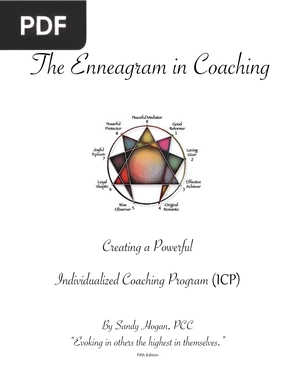
A coaching manual built around the nine archetypes, with essence qualities, strengths, growth edges, basic fears, and healing mottos for each. Includes a framework for designing an individualized coaching program around a client core motivation.
A thesis tracing how Enneagram type shapes the way people communicate. Builds the background on the triads, then runs case study interviews with a Type Nine, a Type Six, and a Type Three to compare their preferences side by side.
Maps the seven factors that keep employees at a company onto Enneagram theory. Makes the case that type aware motivation and retention practices cost less than the recruiting cycle they replace.
A study comparing Enneagram types against scores on a standard creativity and problem solving inventory. Tests whether the problem solving traits commonly attributed to each type hold up in a sample of accurately typed participants.
The Enneagram grew out of contemplative traditions before it reached psychology. These books follow that thread, from the passions of each type to the inner work that leads to transformation.
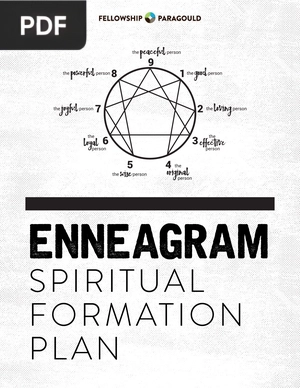
A church guide that treats the Enneagram as a tool for spiritual formation rather than an end in itself. Works through the surface habits of each type and the inner life underneath, with a formation plan for every one of the nine.
Traces the nine passions and their matching virtues back to a fourth century letter recovered from the libraries of Mount Athos. Compares that system with the modern Enneagram and what it means for reading the types today.
Follows a claim Ouspensky recorded about Gurdjieff: that the Enneagram is hidden inside the Book of Revelation. Uses the nine types and the three triangular centers as a key for reading the text allegorically.
The symbol is older than the personality system built on it. These books trace the Enneagram from the Fourth Way through Ichazo and Naranjo to the form it takes today.
A documented search for where the Enneagram actually came from, written by one of the teachers who brought it into wide use. Includes the corrected figures and the erratum issued after the first publication.
Two linked essays, the first a firsthand account of the circle where the modern Enneagram took shape in the 1960s and 70s, the second by Naranjo himself on what he hoped the system would become in education.
Questions the ancient wisdom story the Enneagram is usually sold with. Examines the essentialist and teleological assumptions behind the traditional teaching and what modern philosophy and science do to them.
These Enneagram books give you more than a label. Read a few and you will start to see the strengths, blind spots, and patterns that shape how you and the people around you act.
Send this page to someone who’d love to read it. Everything is free, no sign-up needed.
Esc
Start typing to search...
Searching...
No results found
Try different search terms
Your book is downloading!
If InfoBooks helped you, you can support us in one click: add us as a preferred source on Google. You'll see more of our books when you search, and you'll help us keep sharing free reading with everyone.
Done! Your book is downloading
Know someone who’d enjoy reading it? Send them this page. It’s free, no sign-up needed, and you help us spread the love of reading.