Philosophy of law books ask the questions every legal system has to answer: what law is, why we obey it, and what makes it just. This free collection covers them from ancient Greece to the twentieth century.
You'll find the classics of jurisprudence, from Plato and Kant to Hegel and Bentham. Next to them sit the big debates on natural law, legal realism, punishment and morality.
If you're new to the field, start with Roscoe Pound's introduction and then jump to the school that interests you. Every book downloads free in PDF.
📚
Download every Philosophy of Law book on this page
All the books on this page in one ZIP file, instead of downloading them one by one.
We will redirect you to accounts.google.com to complete sign-in.
Email and name only · We never send spam
Access unlocked
Download every Philosophy of Law book on this page
All the books on this page in one ZIP file, instead of downloading them one by one.
Direct download · One ZIP file
Download started. Check your downloads folder for the ZIP.
Beginners
Introduction to Philosophy of Law Books
If you're new to the philosophy of law, start here. These books explain the basic ideas of jurisprudence and map the main schools of thought.
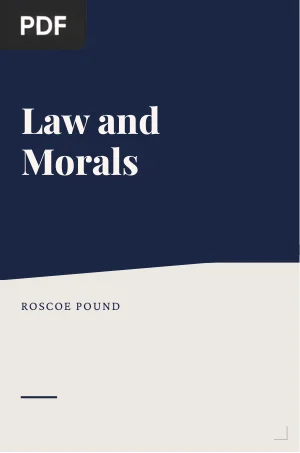
Roscoe Pound's Yale lectures on the questions every legal system must answer: what law is for, how judges apply it, and how it handles property, contract and liability. A clear entry point to jurisprudence from one of its most influential teachers.
A classic textbook that defines the core concepts of legal theory: the nature and sources of law, rights and duties, persons, possession and liability. Written for students, with a closing guide to the literature of jurisprudence.
Holland's Oxford textbook organizes the whole field of law into a single system of rights, persons, acts and remedies. For decades it was the standard first book in jurisprudence courses.
A compact Princeton study outline of the main theories of law, from Austin's command theory and Hart's positivism to Dworkin and natural law. Useful as a map of the field and a quick review before exams.
A short overview of Western philosophy of law, from Hegel and Kelsen to the place of international law. McBride argues for looking beyond the American and British systems that dominate most textbooks.
Plato, Kant, Hegel and Bentham wrote the classic philosophy of law books that law schools still teach. Each one asks where law comes from and what gives it authority.
Socrates waits in prison with an escape plan ready and argues that he must stay and obey the laws that condemned him. Our own Project Aldus edition of the first great dialogue on obedience to the law.
Plato's longest dialogue designs the legal code of a new city, from marriage and property to crime and the role of the gods. Jowett's translation includes a full introduction and analysis of each book.
Kant's theory of right, the first part of the Metaphysics of Morals, covering property, contract, punishment and the authority of the state. It grounds law in freedom rather than in happiness or utility.
Hegel traces how freedom takes shape in law, morality, the family, civil society and the state. Dyde's translation of one of the most debated books in legal and political philosophy.
The founding text of utilitarian legal theory, where Bentham sets out the principle of utility and applies it to offences, punishment and the design of laws. A book that still frames debates on legislation.
Maine follows law from primitive codes and Roman law to modern society and coins the famous movement from status to contract. A founding work of historical jurisprudence.
Jhering's famous lecture argues that rights are won and kept through struggle, and that defending one's own right is a duty to society. Short, forceful and widely read in law schools.
Bastiat's essay on what law is for: protecting life, liberty and property, and what happens when it is turned into a tool of plunder. A short classic of liberal legal thought.
Why did Hegel insist that legal philosophy and legal history must stay apart? This paper reconstructs his argument and uses it to shed light on current debates in common law scholarship.
Natural law says a just law must follow a moral order above human decisions. From Cicero and Aquinas to Grotius, these books show where the idea of universal rights came from.
Cicero's dialogue on true law as right reason in agreement with nature, binding on all peoples at all times. Barham's translation of the text that carried Stoic natural law into the Roman and Christian tradition.
Questions 90 to 97 of the Summa Theologica, where Aquinas defines law and distinguishes eternal, natural, human and divine law. The classic statement of natural law theory, in the English Dominican translation.
Grotius grounds the law of nations in natural law and asks when war is just and how it must be fought. Campbell's translation, with an introduction on Grotius and his influence on international law.
A clear account of the debate between natural law and legal positivism, from Aquinas and Finnis to Hart and Raz, applied to how courts read a written constitution.
A comparative study of how Han Feizi, Hobbes and Habermas relate positive law to natural law, and what that means for legitimacy, rights and global justice today.
For the legal realists, law is what courts actually do. Holmes, Cardozo and Pound wrote the books that changed how American judges think about their work.
The life of the law has not been logic, it has been experience. Holmes's lectures trace liability, contract and possession through history and laid the ground for American legal realism.
Holmes's 1897 address defines law as a prediction of what courts will actually do and separates law from morality. The most cited essay in American jurisprudence.
A judge explains how judges really decide cases, weighing logic, history, custom and social welfare. Cardozo's Yale lectures remain a classic account of judicial reasoning.
Pound examines the forces that shaped the common law, from feudalism and Puritanism to the courts, and calls for a sociological jurisprudence suited to modern society.
Gray argues that law is what the courts lay down, while statutes, precedents and custom are only its sources. A key precursor of legal realism, written with unusual clarity.
Beccaria's treatise against torture and the death penalty, the book that launched modern criminal law reform. This edition adds Farrer's chapters on Beccaria's life and influence.
Bentham's systematic theory of punishment: when it is justified, how to make it proportionate, and which penalties do more harm than good. The utilitarian answer to why the state punishes.
Does a law have to be moral to count as law? H.L.A. Hart and Lon Fuller made it a central question of modern jurisprudence, and these books carry it into human rights and equality.
A clear overview of the main theories of human rights, from natural rights to political accounts, and the questions they raise for law and morality. Written as the introduction to a major collected volume.
Traces the idea of equality from Aristotle and the Stoics to its place in modern human rights law, and maps the different models of equality that legal systems use.
Dworkin's honorary degree lecture on why international law binds states and how a moral reading can strengthen it. A brief, accessible text from a central figure of modern jurisprudence.
Stephen's classic reply to Mill's On Liberty defends the use of law to enforce morality and questions the ideals of the French Revolution. The starting point of the Hart and Devlin debate.
Pound's lectures on how the historical, analytical and philosophical schools understood the relation between law and morals, and why the question matters for judges.
Argues that legal education should engage students' deepest beliefs and that legal philosophy is the place to do it, with proposals for teaching from a Christian perspective.
Send this page to someone who’d love to read it. Everything is free, no sign-up needed.
Esc
Start typing to search...
Searching...
No results found
Try different search terms
Your book is downloading!
If InfoBooks helped you, you can support us in one click: add us as a preferred source on Google. You'll see more of our books when you search, and you'll help us keep sharing free reading with everyone.
Done! Your book is downloading
Know someone who’d enjoy reading it? Send them this page. It’s free, no sign-up needed, and you help us spread the love of reading.