The Apocrypha includes books once part of biblical tradition but excluded from modern Protestant canons. Find Old Testament deuterocanonical works, lost pseudepigrapha, and apocryphal Gospels of the New Testament in free PDF.
This collection brings together 53 apocryphal books in PDF, from Septuagint and Vulgate texts to gnostic Nag Hammadi writings. Each title is a translated, public-domain or open-access edition.
Pick any title to download in PDF, instantly and without signup. Read the Apocrypha alongside the Old Testament and New Testament to see the full biblical landscape.
📚
Download every Apocryphal book on this page
All the books on this page in one ZIP file, instead of downloading them one by one.
We will redirect you to accounts.google.com to complete sign-in.
Email and name only · We never send spam
Access unlocked
Download every Apocryphal book on this page
All the books on this page in one ZIP file, instead of downloading them one by one.
Direct download · One ZIP file
Download started. Check your downloads folder for the ZIP.
Deuterocanonical
Old Testament Apocrypha (Deuterocanonical Books)
These books appeared in the Septuagint and the Vulgate, and remain canonical in the Catholic and Orthodox Bibles. They cover the intertestamental period between the Old and New Testaments.
Greek Septuagint expansions to the Book of Esther that fill in prayers, dreams, and royal decrees absent from the Hebrew text. Reads as a devotional companion to canonical Esther.
Short narrative appended to the Book of Daniel in the Greek Septuagint. Tells how the prophet Daniel saves a falsely accused Babylonian woman, blending courtroom drama with biblical moral lesson.
Two short tales added to Daniel in the Septuagint, in which the prophet exposes the fraud of Babylonian priests and slays a dragon worshipped as a god. Highlights the rejection of idolatry.
Historical account of the Jewish revolt under the Maccabees against the Seleucid Empire in the second century BCE. Recognised as canonical by Catholic and Orthodox traditions.
Companion to 1 Maccabees focused on the temple purification and on theological themes such as resurrection and martyrdom. A foundational source for the festival of Hanukkah.
Alternate Greek version of Ezra-Nehemiah that retells the return from exile and the rebuilding of the temple, with the unique tale of three young guardsmen debating what is strongest in the world.
Jewish apocalyptic work cast as visions of the scribe Ezra after the destruction of Jerusalem. Wrestles with questions of theodicy, the end of the age, and the coming Messiah.
Short prophetic book attributed to Baruch, the secretary of Jeremiah, written during the Babylonian exile. Combines prayer, wisdom poetry, and a vision of restoration for Israel.
Story of a devout Israelite in exile whose son Tobias is guided by the archangel Raphael on a journey of healing and marriage. A blend of folktale, ethics, and prayer.
Dramatic narrative of the widow Judith, who saves her city from the Assyrian general Holofernes through cunning and courage. A celebrated example of biblical heroism by a female figure.
Hellenistic Jewish meditation on divine wisdom, righteousness, and immortality, written in the voice of King Solomon. Bridges Hebrew scripture and Greek philosophy.
Extensive collection of wisdom sayings by Jesus ben Sira, covering ethics, family life, friendship, and the fear of God. Recognised as Deuterocanonical Scripture by Catholic and Orthodox Churches.
Short prayer of repentance attributed to king Manasseh of Judah, asking God for forgiveness of his many sins. Often used as a devotional model of contrition.
Short prophetic letter attributed to Jeremiah, warning Jewish exiles in Babylon against idolatry. Counted as chapter 6 of Baruch in Catholic and Orthodox Bibles.
Greek Septuagint addition to Daniel chapter 3. Combines the prayer of Azariah in the furnace with a hymn of praise sung by the three young men spared from the flames.
The Pseudepigrapha are Jewish religious writings from the Second Temple period attributed to biblical figures like Enoch, Moses, or Adam. They are not part of any official biblical canon but offer rich apocalyptic, wisdom, and historical content.
Apocalyptic compilation attributed to the patriarch Enoch in R.H. Charles classic translation. Includes the Book of the Watchers, the Parables, and visions of fallen angels and the messianic age.
Retelling of Genesis and Exodus organised by Jubilees of 49 years, attributed to Moses on Mount Sinai. Central in Second Temple Jewish thought and preserved as scripture by the Ethiopian Orthodox Church.
Greek pseudepigraphal narrative also known as the Life of Adam and Eve. Tells how the first couple lived after their expulsion from Eden, with vivid detail about temptation, illness, and repentance.
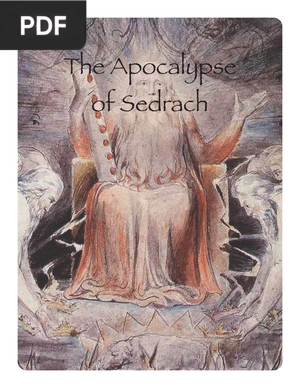
Late apocalyptic dialogue in which the patriarch Sedrach pleads with God for mercy on a sinful humanity. A meditation on divine justice and the limits of repentance.
Latin recension of the post-Eden life of Adam and Eve, paralleling the Greek Apocalypse of Moses with additional episodes of penance, the death of Adam, and visions of paradise.
Greek romance from Hellenistic Jewish circles that retells the marriage of Joseph and the Egyptian priestess Aseneth. Combines conversion narrative, mystical vision, and adventure.
Collection of fourteen books of Greco-Roman pseudo-prophetic oracles translated in blank verse by Milton S. Terry. Cited frequently by the early Church Fathers as testimony to Christ.
Collection of 42 mystical hymns from early Syriac Christianity, translated by J. Rendel Harris. Often called the oldest Christian hymnbook outside the Psalter.
Account of a planned massacre of Egyptian Jews under Ptolemy IV Philopator and their miraculous deliverance. Read as Deuterocanonical by the Greek and Russian Orthodox Churches.
Philosophical treatise on the supremacy of reason over the passions, illustrated by the martyrdom of Eleazar and the seven brothers under Antiochus IV. Appears as an appendix to the Greek Septuagint.
Also called the Syriac Apocalypse of Baruch. A Jewish apocalyptic response to the destruction of Jerusalem, exploring divine justice, the end of the age, and the resurrection of the dead.
Twelve final speeches in which the sons of Jacob teach their descendants from their deathbeds. R.H. Charles 1908 critical edition with introduction, translation, and notes.
Hebrew text mentioned in Joshua and 2 Samuel, retelling biblical history from Adam to the conquest of Canaan. Translated from the rabbinical Hebrew Sefer ha-Yashar in 1840.
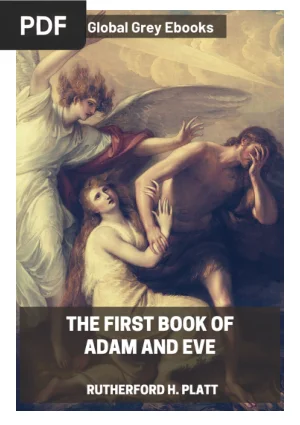
Pseudepigraphal narrative detailing the life of Adam and Eve after their expulsion from Eden, through the murder of Abel by Cain. From the 1927 Forgotten Books of Eden collection.
The New Testament Apocrypha includes gospels, acts, epistles, and apocalypses written in the early Christian centuries but excluded from the canon. Many were rediscovered in the Nag Hammadi Library in 1945, giving direct access to gnostic Christianity.
Collection of 114 hidden sayings of Jesus discovered in the Nag Hammadi library in 1945. A central text of Gnostic Christianity, valued for its emphasis on inner knowledge and the kingdom within.
Second century Gnostic dialogue between Jesus and Judas Iscariot, presenting Judas as a chosen disciple rather than a traitor. Translated by Kasser, Meyer, and Wurst from the Codex Tchacos.
Apocryphal acts narrating the conversion and adventures of Thecla, a young woman who follows the apostle Paul. An early example of Christian fiction centred on a female disciple.
Vision of heaven and hell attributed to the apostle Peter, here presented in S. Kent Brown and C. Wilfred Griggs scholarly introduction and translation for BYU Studies Quarterly.
Fourth century vision of the apostle Paul touring heaven and hell. The text shaped medieval depictions of the afterlife and inspired later works such as Dante's Divine Comedy.
Early Christian apocalypse from second century Rome, structured as visions, mandates, and parables delivered to Hermas by a heavenly Shepherd. Widely read as scripture in some early Churches.
Surviving fragments of the gospel used by the Ebionites, a Jewish Christian sect that rejected Paul and kept Torah observance. Reconstructs how an alternative early Christianity read the life of Jesus.
Narrative built around the trial of Jesus before Pilate and his descent into hell, also known as the Acts of Pilate. Translated by M.R. James in his 1924 Apocryphal New Testament.
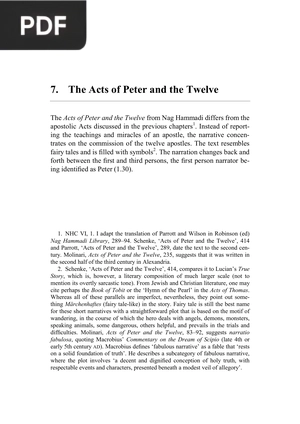
Second century infancy gospel describing the birth and childhood of Mary and the nativity of Jesus. Shaped Catholic and Orthodox tradition about Joachim, Anna, and the early life of the Virgin Mary.
Third century Gnostic text recovered at Nag Hammadi, presenting cryptic sayings on marriage, sacraments, and spiritual transformation. Translated by Wesley W. Isenberg.
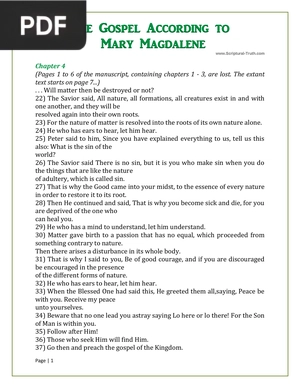
Surviving fragments of a Gnostic gospel in which Mary Magdalene recounts a private vision of Jesus and is challenged by Peter and Andrew. A landmark text for early Christian views of women.
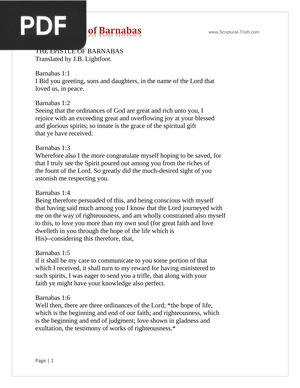
Late first or early second century epistle, translated by J.B. Lightfoot, that reinterprets the Old Testament in light of Christ. Treated as scripture by Clement of Alexandria and Origen.
Nag Hammadi narrative in which the apostles meet a mysterious pearl merchant named Lithargoel, who reveals himself as Christ and sends them out to heal the poor. Combines parable, vision, and missionary charge.
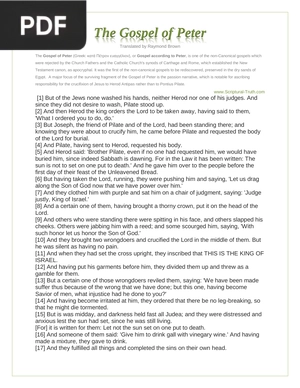
Surviving Akhmim fragment of an early second century passion gospel translated by Raymond Brown. Notable for assigning responsibility for the crucifixion to Herod rather than Pilate.
Disputed fragment from a letter attributed to Clement of Alexandria, quoting a longer version of Mark with extra passages about Jesus and a young initiate. Translated by Morton Smith.
Anonymous Gnostic treatise from Nag Hammadi that offers a creation myth alternative to Genesis. Surveys the origin of chaos, archons, and the spiritual cosmos.
Late first century letter from the Church of Rome to the Church of Corinth, attributed to Clement. Addresses schism, leadership, and apostolic succession in the earliest post-apostolic period.
Valentinian Gnostic homily from Nag Hammadi celebrating the revelation of the Father through Christ. Translated by Robert M. Grant. A central text of Gnostic theology and aesthetics.
Second century dialogue gospel in epistolary form, in which the risen Christ teaches the apostles in question and answer style. Anthony Alcock translation of the Coptic text.
Fourteen short letters exchanged between the apostle Paul and the Roman philosopher Seneca, preserved by Jerome and Augustine. Translated by M.R. James in 1924.
Foundational Sethian Gnostic text recovered at Nag Hammadi. Frederik Wisse translation presenting a Gnostic creation myth and the redemption of humanity through divine revelation.
Coptic Gnostic scripture from the Askew Codex translated by G.R.S. Mead in 1921. Records the dialogues of the risen Jesus with his disciples on the mysteries of light and salvation.
Nag Hammadi dialogue gospel in which the risen Christ instructs his disciples on the unknown God and the origins of the cosmos. Adapts the older non-Christian Eugnostos the Blessed.
Apocryphal narrative in which the apostle Bartholomew questions the risen Christ, the Virgin Mary, and Satan about hidden mysteries. Also known as the Questions of Bartholomew.
Third century apocryphal narrative of the apostle Thomas evangelising India. Combines miracle stories, the Hymn of the Pearl, and ascetic teaching from early Syriac Christianity.