
The Formation of Vegetable Mould through the action of worms with observations of their habits by Charles Darwin [PDF]
by InfoBooks
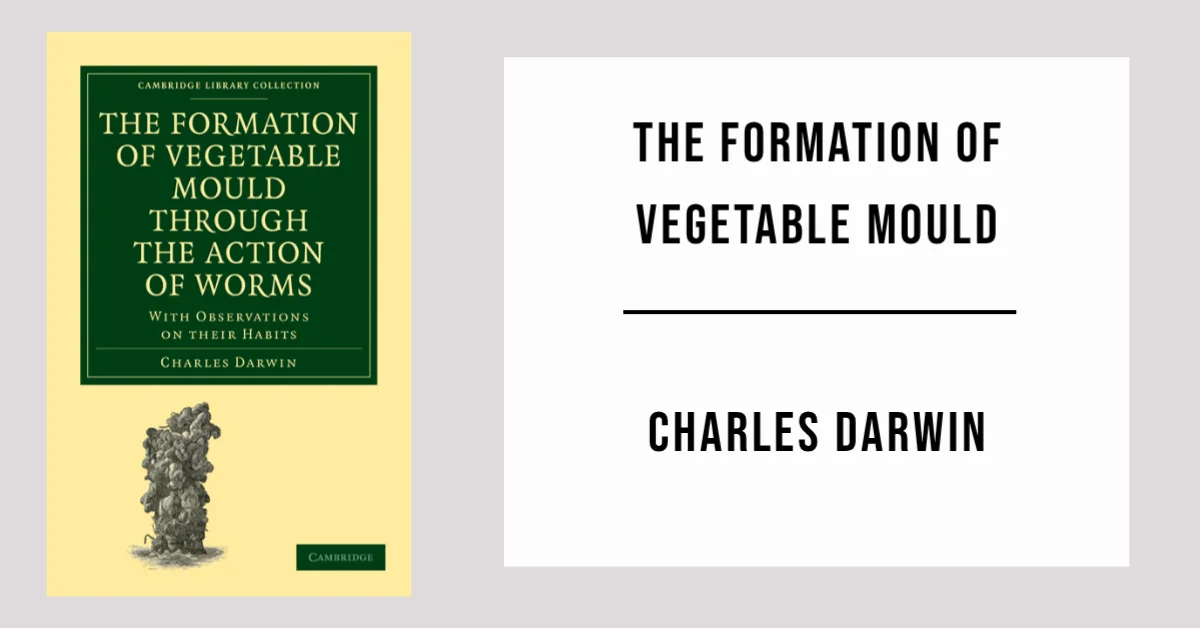
Charles Darwin spent over four decades watching earthworms work. The result is one of the most surprisingly engaging science books you will ever read. In this final work, he reveals how these small creatures play a central role in shaping the earth's surface.
Darwin's observations go well beyond biology. Download the free PDF and discover how earthworms bury ruins, create fertile soil, and slowly move stones across fields. The book blends careful experiments with a genuine sense of wonder at what worms can do.
If you are interested in ecology, geology, or the history of science, this book connects all three. Darwin proves that paying close attention to something ordinary can lead to extraordinary conclusions.
The Formation of Vegetable Mould through the action of worms with observations of their habits by Charles Darwin
*Please wait a few seconds for the document to load, the time may vary depending on your internet connection. If you prefer, you can download the file by clicking the link below.
Loading PDF...
Information: The Formation of Vegetable Mould through the action of worms with observations of their habits
- Author: Charles Darwin
- Publication Date: 1881
- Main Characters:
- Earthworm Behavior and Intelligence: Darwin's detailed observations of how worms sense light, respond to vibrations, and make choices about leaf-dragging. He argues they possess rudimentary reasoning abilities.
- Soil Formation and Turnover: The process by which worms bring fine earth to the surface as castings, gradually creating and renewing the layer of vegetable mould (topsoil) that supports all plant life.
- Burial of Ancient Structures: Darwin documents how worm activity slowly buries Roman villas, Stonehenge stones, and other structures under layers of fresh soil, preserving them for archaeologists.
- Uniformitarianism: The geological principle that small, steady forces acting over long periods produce large-scale changes. Darwin applies this idea to worm activity and landscape transformation.
- Denudation and Erosion: The gradual wearing down of land surfaces through worm-loosened soil being washed away by rain, contributing to the slow reshaping of hills and valleys.
- Brief Summary: The Formation of Vegetable Mould is Darwin's detailed study of how earthworms create and maintain topsoil. Through decades of experiments at his home in Down House, Kent, Darwin measured how much earth worms bring to the surface, how they drag leaves into burrows, and how their constant activity buries objects over time. The book covers worm anatomy, senses, and habits before moving to their geological effects: the burial of ancient Roman ruins, the leveling of fields, and the slow erosion of hillsides. Darwin concludes that worms have played a more important part in the history of the world than most people would suppose.
- Thematic Analysis: The central theme is uniformitarianism: the idea that small, continuous actions produce large effects over long periods. Darwin applies this same principle from his evolutionary work to geology, showing how worms gradually reshape landscapes. A second theme is animal intelligence. Darwin carefully tests whether worms can make decisions about how to pull leaves, arguing they possess a basic sense of shape. The book also explores the relationship between living organisms and geological processes, making it an early contribution to what we now call ecosystem science.
- Historical Context: Published on October 10, 1881, this was Darwin's last scientific book. He had first presented a paper on worms to the Geological Society of London in 1837, so the work represents over 40 years of research. By 1881, Darwin was already world-famous for On the Origin of Species (1859) and The Descent of Man (1871). Despite his expectation that a book about worms would attract little attention, it became an immediate bestseller, moving 6,000 copies in its first year. The book contributed to the emerging field of soil science and anticipated modern ecology's focus on how organisms engineer their environments.
Books by Charles Darwin
Coral Reefs by Charles Darwin
On the Origin of Species by Charles Darwin
The Autobiography of Charles Darwin by Charles Darwin
The Descent of Man by Charles Darwin
The Different Forms of Flowers on Plants of the Same Species by Charles Darwin
The Expression of the Emotions in Man and Animals by Charles Darwin
The Movements and Habits of Climbing Plants by Charles Darwin
The Variation of Animals and Plants Under Domestication Vol 1 by Charles Darwin
The Voyage of the Beagle by Charles Darwin
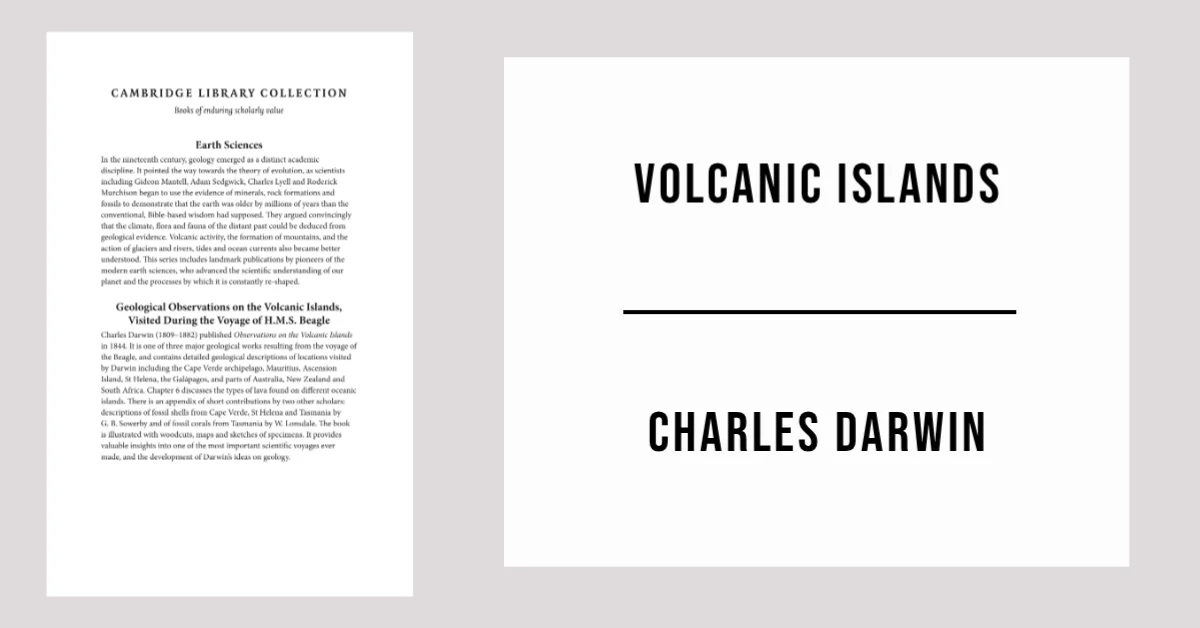
Volcanic Islands by Charles Darwin