13 Free Zen Buddhism Books [PDF]
by InfoBooks

Looking for Zen Buddhism books in PDF? This page gathers 13 free titles, from foundational sūtras and koan collections to modern guides on zazen.
All titles are public domain works or PDFs released by recognized Zen centers. You will find the texts that shaped how Sōtō, Rinzai, and Thiền teachers passed Zen from the Buddha's lineage to the West.
Read them online or download for free. If a title helps you sit, pass it on.
Download every Zen book on this page
All the books on this page in one ZIP file, instead of downloading them one by one.
We will redirect you to accounts.google.com to complete sign-in.
Email and name only · We never send spam
Download every Zen book on this page
All the books on this page in one ZIP file, instead of downloading them one by one.
Direct download · One ZIP file
Download started. Check your downloads folder for the ZIP.
Books on Zen Buddhism Foundations
Zen Buddhism traces back through Chinese Chan to the Buddha himself. These books are where the lineage speaks, from Huang Po's transmission to Dōgen Zenji's instructions to his disciples.
-
The historical sermons and dialogues of the Tang-dynasty Chan master Huang Po (d. 850 AD), translated into English by John Blofeld. A direct, paradox-driven account of mind-transmission that became one of the founding texts of the Lin Chi (Rinzai) school.
Verified PDF · Secure download -
An academic paper by Yong Zhi (Temple University) that unpacks the four classical Zen mottos: special transmission outside doctrine, not establishing language, direct pointing to the mind, and seeing one's nature to attain Buddhahood. Strong on the linguistic philosophy behind Zen expression.
Verified PDF · Secure download
Books on Zen Meditation and Zazen
Zazen sits at the heart of Zen practice. The guides below cover posture, breath, and the inner orientation that turns sitting into more than sitting.

Books on Zen Stories and Koans
Zen is famous for its stories. These koans short-circuit logical thinking, so read them slowly.
-

The classic compilation of 101 Zen koans and anecdotes transcribed by Nyogen Senzaki and Paul Reps in 1919, drawing on the 13th-century Japanese collection Shaseki shu. Includes A Cup of Tea, Is That So?, The Sound of One Hand, and other foundational stories.
Verified PDF · Secure download

Books on Zen Masters and Classic Teachings
These are the books that opened Zen to the West. D.T. Suzuki, Shunryu Suzuki, and Dōgen Zenji are the entry points cited by almost every contemporary Zen teacher.
-
D.T. Suzuki's 1935 foundational anthology of Zen Buddhism. Gathers gathas, dharanis, sutras (Heart Sutra, Diamond Sutra, Lankavatara), and translations of the Chinese masters Bodhidharma, Hui-neng, Huang Po and others. The single volume that introduced Zen to the West.
Verified PDF · Secure download -
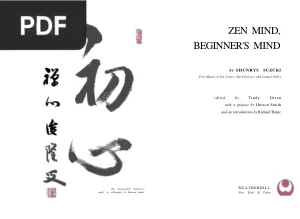
The single most-read Zen book in English. Talks by Shunryu Suzuki, founder of San Francisco Zen Center, edited by Trudy Dixon, with a preface by Huston Smith. Covers posture, breath, right effort, single-mindedness, and the spirit of beginner's mind in plain language.
Verified PDF · Secure download -
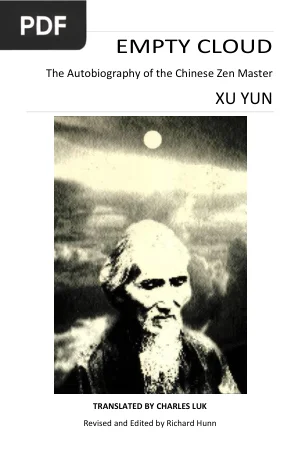
The autobiography of Xu Yun (1840-1959), the modern Chinese Chan patriarch who revived monasteries and trained generations of teachers. Translated by Charles Luk and edited by Richard Hunn, this is the firsthand account of a hundred and twenty-year practice life.
Verified PDF · Secure download

Each of these titles connects to a longer tradition of practice and study. Pick the one that meets you where you are.
Want more spiritual texts? Browse our full collection of Esotericism books in PDF.
You Might Also Like
Buddhism Books
Dharma, meditation, enlightenment. The teachings and practices of Buddhism.
Taoism Books
Tao, harmony, nature. The Chinese philosophy of living in harmony with the Way.
Meditation Books
Mindfulness, focus, inner peace. Practices to quiet the mind and find balance.

Eastern Philosophy Books
Wisdom, harmony, contemplation. Philosophical traditions from Asia and the East.