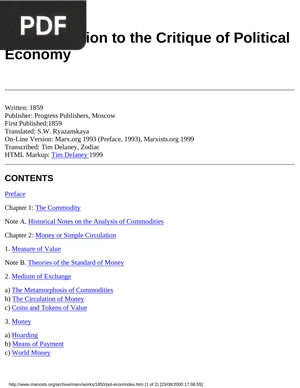
A Contribution to the Critique of Political Economy
Karl Marx
Marx's 1859 first draft of his economic theory, where he analyzes the commodity and money before writing Capital. Its preface holds the most compact summary he ever gave of historical materialism, the idea that the economic base shapes law, politics and ideas.
Loading the book...
Keep reading
-
Next in this topic
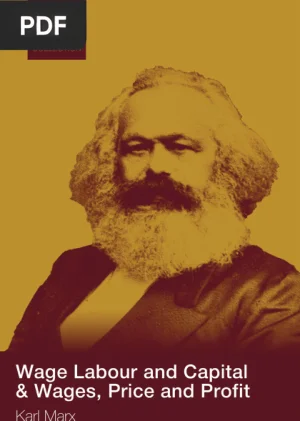
Wage Labour and Capital & Wages, Price and ProfitTwo short lectures Marx gave to workers, and the easiest door into his economics. They explain in plain language what wages are, where profit comes from and why the interests of labor and capital collide, which makes them the ideal step before Capital.
Verified PDF · Secure download - Manifesto of the Communist Party & Principles of Communism
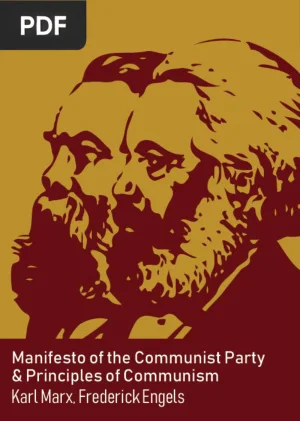
The 1848 pamphlet that opens with "A spectre is haunting Europe" and closes with a call for the workers of the world to unite. This edition adds all the prefaces Marx and Engels wrote for later editions, plus Engels' Principles of Communism, the draft the Manifesto grew out of.
Verified PDF · Secure download - The Eighteenth Brumaire of Louis Bonaparte
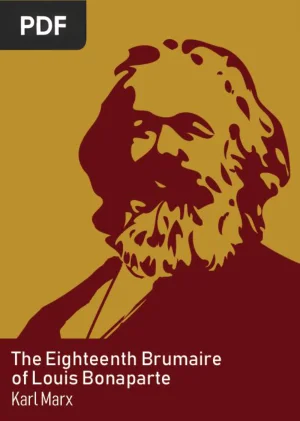
Marx's sharp account of how Louis Bonaparte seized power in France in 1851, the essay that begins with history repeating itself, first as tragedy, then as farce. It is his finest piece of historical writing, showing class struggle at work in real politics.
Verified PDF · Secure download - The Class Struggles in France
Written in 1850, this is Marx's first attempt to explain a revolution as it unfolded, following France from the February Revolution of 1848 to the defeat of the workers. It includes Engels' 1895 introduction, one of his last texts.
Verified PDF · Secure download - The Civil War in France
Marx's addresses to the First International on the Franco-Prussian War and the Paris Commune of 1871. He defends the Commune as the first government of the working class and draws from it his lessons on the state.
Verified PDF · Secure download

Explore more Classic Authors
- Fyodor Dostoevsky
- Agatha Christie
- Franz Kafka
- Sigmund Freud
- William Shakespeare
- Aristotle
- Plato
- Friedrich Nietzsche