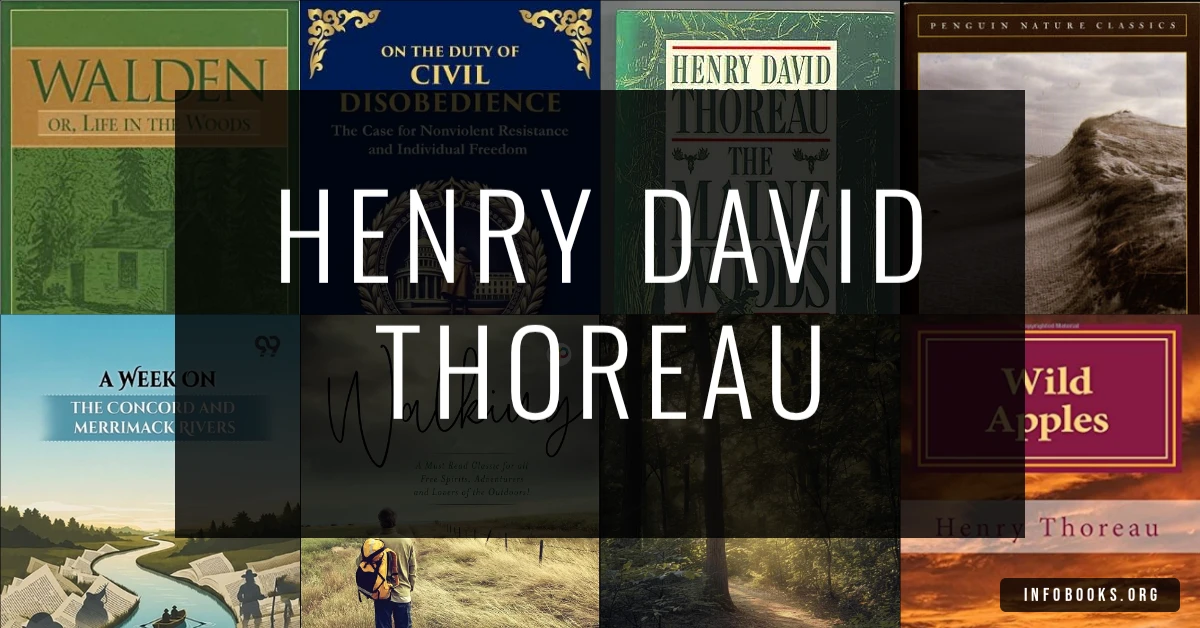
Looking for Henry David Thoreau books? Thoreau (1817-1862) was the Concord, Massachusetts writer who built a cabin by Walden Pond and turned two years of simple living into Walden, one of the most read classics of American literature.
He only published two books in his lifetime, but his essays, journals and nature writing filled twenty volumes after his death. A friend and student of Ralph Waldo Emerson, he became the most practical voice of Transcendentalism.
Here you have 17 of his works, from Walden and Civil Disobedience to Cape Cod and his poems. Every book is free to read online or download as PDF.
📚
Download every book on this page in one click
Sign in with Google and grab them all without going one by one.
We will redirect you to accounts.google.com to complete sign-in.
Email and name only · We never send spam
Access unlocked
Download every book on this page in one click
Get them all together, without going one by one.
Direct download · One ZIP file
Download started. Check your downloads folder for the ZIP.
Nature Books
Walden and Thoreau's Nature Books
Walden is the start for most readers, but Thoreau also wrote about rivers, forests and the open Atlantic coast. The Maine Woods and Cape Cod read like travel journals, full of storms, guides and wild landscapes.
The classic that made Thoreau famous: two years alone in a cabin he built at Walden Pond, testing how little a person really needs to live well. Start here if you are new to him.
Thoreau's first book, the story of a boat trip with his brother that becomes a meditation on nature, friendship, poetry and religion. Written in part during his stay at Walden.
Three trips into the Maine wilderness, including the climb of Mount Katahdin and long canoe journeys with Penobscot guides. Thoreau's most adventurous book, with appendices on the trees, birds and gear of each trip.
Thoreau walks the outer beach of Cape Cod from Eastham to Provincetown, past shipwrecks, oystermen and lighthouses. A vivid travel book, here in the 1908 edition illustrated with photographs by Clifton Johnson.
His witty account of a trip by train and steamboat to Montreal and Quebec in 1850, followed by his anti-slavery and reform papers, from Slavery in Massachusetts to The Last Days of John Brown. The complete 1866 volume.
The 1863 collection of his best nature essays, from A Winter Walk and A Walk to Wachusett to Autumnal Tints and Night and Moonlight. It opens with Emerson's biographical sketch of his friend.
In 1846 Thoreau spent a night in jail for refusing to pay a tax, and his essay about it, Civil Disobedience, later inspired Gandhi and Martin Luther King Jr. His other essays move from politics to long walks and wild apples, always with the same sharp eye.
The short essay in which Thoreau argues that conscience comes before the law and explains why he went to jail rather than pay a tax. It later inspired Gandhi and Martin Luther King Jr.
Thoreau's essay on the art of walking and the value of wildness, home of his famous line about wildness being the preservation of the world. A defense of nature against a world in a hurry.
The fiery speech Thoreau gave on July 4, 1854, weeks after Boston sent the fugitive Anthony Burns back to slavery. A short, angry text against laws that ask good people to obey injustice.
Read to his Concord neighbors in October 1859, days after the raid on Harpers Ferry, this is Thoreau's bold defense of John Brown at a time when almost everyone else condemned him.
One of his last essays, a playful history of the apple tree that turns into praise of everything wild and overlooked. Thoreau at his warmest and funniest.
A guide to the colors of New England in the fall, from purple grasses to scarlet oaks, written in his final years. It teaches you to really look at the trees around you.
Thoreau kept a journal for almost 25 years, and many pages of Walden were born there. Start with his nature poems if you want something short, or open the journals to see how he thought day by day.
The first volume of the journal Thoreau kept for almost 25 years, from 1837 to 1846: his early years in Concord, his friendship with Emerson and his move to Walden Pond. Many pages of Walden were born here.
His journal from 1850 to September 1851, full of long walks, close looks at plants and animals, and the ideas that later grew into Walking. A window into how Thoreau thought and worked day by day.
Thoreau's letters to family and friends, Emerson among them, edited by his friend Franklin Sanborn. They show the warm, funny and private side of a writer often seen as a hermit.
Send this page to someone who’d love to read it. Everything is free, no sign-up needed.
Esc
Start typing to search...
Searching...
No results found
Try different search terms
Your book is downloading!
If InfoBooks helped you, you can support us in one click: add us as a preferred source on Google. You'll see more of our books when you search, and you'll help us keep sharing free reading with everyone.
Done! Your book is downloading
Know someone who’d enjoy reading it? Send them this page. It’s free, no sign-up needed, and you help us spread the love of reading.