
Volcanic Islands by Charles Darwin [PDF]
by InfoBooks
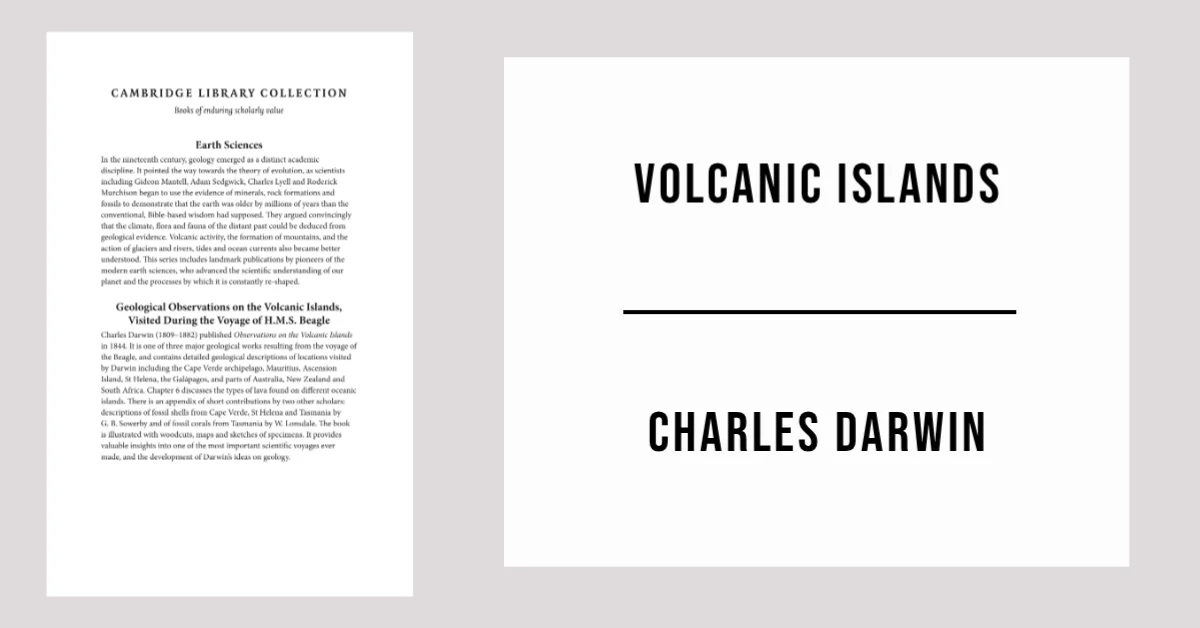
Before Darwin changed biology forever, he was a geologist. Volcanic Islands captures his sharp eye turned toward lava flows, crater formations, and the slow forces that build and erode islands over millennia. Published in 1844, this is the second volume from the geology of the Beagle voyage.
Darwin walks you through St. Jago, Ascension, St. Helena, and the Galapagos, examining rock by rock how volcanic islands form and change. You can download this free PDF and follow Darwin's fieldwork across some of the most geologically active places on Earth. His observation that crystals sink in cooling basalt was decades ahead of its time.
If you've only known Darwin as the evolution guy, this book reveals a different side. His geological reasoning is precise, his descriptions vivid, and his ability to connect observations across thousands of miles of ocean is what made him one of the great scientific minds of the 19th century.
Volcanic Islands by Charles Darwin
*Please wait a few seconds for the document to load, the time may vary depending on your internet connection. If you prefer, you can download the file by clicking the link below.
Loading PDF...
Information: Volcanic Islands
- Author: Charles Darwin
- Publication Date: 1844
- Main Characters:
- Volcanic Rock Classification: Darwin's systematic distinction between basaltic and trachytic rock series, including analysis of their mineral composition, texture, and formation conditions.
- Crater Morphology: Detailed study of volcanic crater shapes, truncation patterns, and the processes of eruption and erosion that create them.
- Elevation and Subsidence: The theory that oceanic islands undergo cycles of rising and sinking, with volcanic regions associated with uplift and coral reef regions with subsidence.
- Fractional Crystallization: Darwin's observation that crystals sink in cooling basaltic lava, separating minerals by weight. This was the first proposal of magmatic differentiation through crystallization.
- Denudation: The gradual wearing away of volcanic cones and formations through wind, water, and wave action over geological time.
- Lines of Fissure: Darwin's analysis of how volcanic eruptions follow linear fault patterns, connecting surface features to deeper geological structures.
- Brief Summary: Volcanic Islands documents Charles Darwin's geological observations from the HMS Beagle voyage (1832-1836). Published in 1844, the book covers volcanic formations across St. Jago, Ascension Island, St. Helena, and the Galapagos Archipelago. Darwin examines lava flows, crater morphology, rock composition, and the processes of elevation and subsidence that shape oceanic islands. The work includes his early proposal of fractional crystallization in magma, a concept later confirmed in the 20th century.
- Thematic Analysis: The book is organized around two central themes: the classification of volcanic rocks and the dynamic geological processes that shape islands. Darwin systematically distinguishes between basaltic and trachytic rock series, tracing how different minerals and textures result from varying conditions of cooling and pressure. He connects local observations to broader patterns, noting how lines of volcanic activity align across ocean basins. The relationship between areas of volcanic uplift and coral reef subsidence forms a recurring thread, linking this work to his earlier Coral Reefs volume. Throughout, Darwin uses precise field observation to build theoretical frameworks about how the Earth's surface changes over time.
- Historical Context: Darwin wrote Volcanic Islands at his home in Down, Kent, between 1842 and 1844, working from notebooks filled during the Beagle voyage (1832-1836). It was the second of three geological volumes from the expedition, published by Smith, Elder and Co. in November 1844. At the time, geology was the dominant natural science, and Darwin considered himself primarily a geologist. Charles Lyell's Principles of Geology had deeply influenced Darwin's thinking, and this work applies Lyell's uniformitarian approach to volcanic landscapes. The book appeared the same year Darwin wrote his first extended essay on natural selection, though that work would not be published for another fifteen years.
Books by Charles Darwin
Coral Reefs by Charles Darwin
On the Origin of Species by Charles Darwin

The Autobiography of Charles Darwin by Charles Darwin
The Descent of Man by Charles Darwin

The Different Forms of Flowers on Plants of the Same Species by Charles Darwin

The Expression of the Emotions in Man and Animals by Charles Darwin

The Formation of Vegetable Mould through the action of worms with observations of their habits by Charles Darwin
The Movements and Habits of Climbing Plants by Charles Darwin

The Variation of Animals and Plants Under Domestication Vol 1 by Charles Darwin

The Voyage of the Beagle by Charles Darwin