Watchmaking is the patient craft of building and repairing mechanical watches. Every watchmaker studies books that cover the movement, balance wheel, and escapement of each clock.
Our free watchmaking books in PDF cover every part of the trade. You will find practical manuals on cleaning and adjusting movements, plus references on Swiss and American watch traditions.
Download these horology books in PDF and read at your own pace. The collection serves both beginners learning the basics and intermediate makers studying escapement theory or watch repair.
📚
Download every Watchmaking book on this page
All the books on this page in one ZIP file, instead of downloading them one by one.
We will redirect you to accounts.google.com to complete sign-in.
Email and name only · We never send spam
Access unlocked
Download every Watchmaking book on this page
All the books on this page in one ZIP file, instead of downloading them one by one.
Direct download · One ZIP file
Download started. Check your downloads folder for the ZIP.
Fundamentals
Watchmaking Fundamentals Books
These books cover the foundations of the watchmaker's trade. They explain tools, workshop setup, basic movement anatomy, and the step-by-step processes a beginner needs before touching a real calibre.
A classic French watchmaking treatise translated into English by Richard Watkins. Covers the workshop, tools, steel and brass work, file techniques and step-by-step procedures every apprentice needs to learn the trade.
A complete study of the American watchmakers' lathe and its attachments. Goodrich explains construction, accessories, proper use and common abuses, with chapters for students and apprentices learning to turn pivots, shafts and small parts.
Comprehensive Victorian manual by the vice-president of the British Horological Institute. Covers the principles of escapements, train design, materials, finishing and the complete construction of watches and clocks for the trade student.
A foundational alphabetical reference for horologists. Britten gathers definitions, formulas, tables and workshop techniques covering every aspect of the trade, from balance springs and escapements to gilding and tempering.
Thomas Reid's pioneering theoretical and practical treatise covering pendulums, escapements, train calculations, repeating mechanisms and chronometers. A central nineteenth-century text used by generations of horologists.
A 19th-century compendium of formulas and workshop tips for watchmakers and jewelers. Collects soldering recipes, cleaning solutions, polishing methods and bench techniques drawn from private formulae and the best authorities of the era.
Watch repair manuals focused on cleaning, oiling, adjusting and servicing mechanical movements. These are practical references used by working watchmakers, several drawn from horological institute archives.
Technician-grade lesson from the British Horological Institute covering motion work, pendulum rods, pivots, beat adjustment, broaches, taps and dies. Includes written exercises used in professional training.
Hands-on repair manual covering the workbench, the vise and oilstone, lathe appliances, the Jacot lathe, depthing tools, expanding wheel webs and the rounding-up tool. Practical bench-level instruction.
A practical guide to the inspection, repair and construction of clocks. Covers cleaning, oiling, bushings, pivot work, escapement adjustment and the building of simple movements from scratch.
A concise hands-on guide to repairing common clock faults. Randell walks the reader through diagnosing stoppages, adjusting beats, replacing mainsprings and oiling pivots, written for the apprentice and the home worker.
Horology history texts that trace watchmaking from early mechanical clocks to the American system of manufacturing and the rise of Swiss precision. Useful context for anyone studying how the trade evolved across centuries.
Traces how American manufacturers like Waltham and Elgin invented mass production of mechanical watches in the 19th century. A detailed historical and technical study of factory methods, machinery and the Boston Watch Company insolvency records.
Kendal traces the origin and development of every method of measuring time, from sundials and water clocks to the spring-driven watch and the chronometer. A complete narrative history written by a member of the British Horological Institute.
Beckett's classic treatise pairs the history of clocks and pendulums with detailed theory of escapements, including his own gravity escapement and a chapter on bells. A reference text for anyone studying nineteenth-century English horology.
A readable survey of antique clocks for collectors and enthusiasts. Hayden covers lantern clocks, longcase clocks, bracket clocks, French and Dutch styles, with photographs, maker lists and notes on identifying genuine pieces.
Escapement is the heart of every mechanical watch. These books explain the lever, cylinder, chronometer and detent escapements with theory, diagrams and practical adjustment notes.
A complete study of the lever, cylinder and chronometer escapements in theory and practice. Compiled from the Keystone serials with nearly two hundred original illustrations, including a brief account of the origin and evolution of the escapement in horology.
Grossmann's prize-winning treatise on the detached lever escapement, with detailed diagrams of rack levers, Mudge's fork, and modern lever forms. Covers the action of pallets and rollers, banking, draw, and the geometry of escapement adjustment.
Wilkinson teaches the watch repairer how to read, test and correct the lever escapement. Each lesson covers a specific error, from the draw and impulse angles to the safety roller, with workshop tests for detecting and curing it.
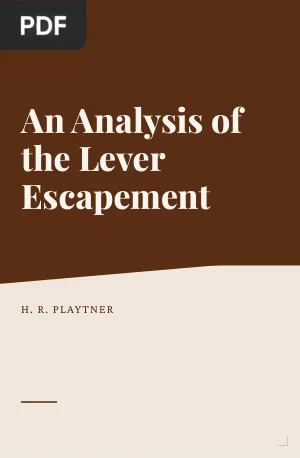
A concise geometric and mechanical analysis of the lever escapement, with full plates showing the trajectories of the pallets and the action of the safety roller. Aimed at watchmakers who want the underlying theory of their adjustments.
Here ends our selection of free watchmaking books in PDF. Whether you want to service a vintage watch or study how the trade began, the collection above is a complete starting point.
If InfoBooks helped you, you can support us in one click: add us as a preferred source on Google. You'll see more of our books when you search, and you'll help us keep sharing free reading with everyone.