Positive psychology studies what makes life worth living. It looks at the strengths, habits, and relationships that help people flourish instead of just getting by.
Martin Seligman founded the field in 1998, and his PERMA model still organizes most of what you will read here. It covers positive emotion, engagement, relationships, meaning, and accomplishment.
This collection maps the field across happiness and well-being, gratitude, optimism, character strengths, and how the research plays out in classrooms and at work. Every title is free to download, with no registration and no waiting.
📚
Download every Positive Psychology book on this page
All the books on this page in one ZIP file, instead of downloading them one by one.
We will redirect you to accounts.google.com to complete sign-in.
Email and name only · We never send spam
Access unlocked
Download every Positive Psychology book on this page
All the books on this page in one ZIP file, instead of downloading them one by one.
Direct download · One ZIP file
Download started. Check your downloads folder for the ZIP.
Foundations
Positive Psychology Books
These are the foundations of positive psychology: what the field studies, how it measures well-being, and where its ethical limits sit. Start here if the discipline is new to you.
A compiled university reader covering the core building blocks of the field, from goal setting and self-regulation to strengths, emotions, and psychological well-being. The broadest single text in this collection.
A full distance-learning course text organized in five blocks, moving from definitions and history to happiness, positive emotions, strengths, and applications. Each unit closes with self-assessment questions.
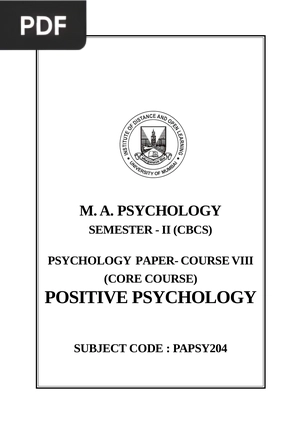
A course manual that walks through the whole syllabus of the discipline: definitions and goals, happiness and subjective well-being, positive emotional and cognitive states, and prosocial behavior. Compact and easy to follow.
A postgraduate course text that introduces the field unit by unit, covering eastern and western views of well-being, positive emotions, wisdom, courage, and flow. Written for self-study.
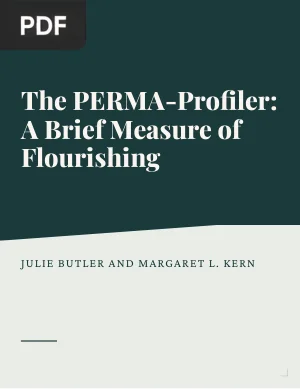
The full development report for the PERMA-Profiler, the standard questionnaire built on the five pillars of well-being: positive emotion, engagement, relationships, meaning, and accomplishment. Includes the complete item set and the scoring method.
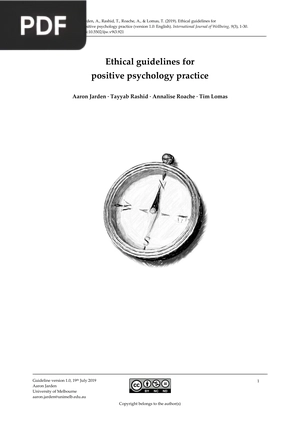
The first published set of ethical guidelines for practitioners in the field, covering values, competence, informed consent, and the limits of positive interventions. Essential reading before applying these methods with other people.
Aaron Jarden, Tayyab Rashid, Annalise Roache and Tim Lomas
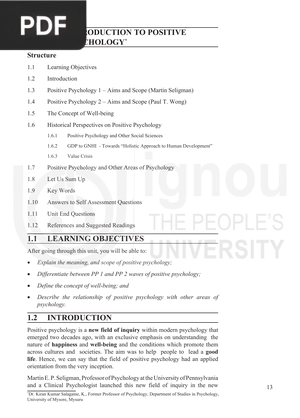
A short opening unit that defines the field, contrasts the first and second waves of positive psychology, and places it next to health, clinical, and developmental psychology. A good first read.
A meta-analysis of 39 randomized trials with more than 6,000 participants, measuring how much positive psychology interventions actually improve well-being and reduce depression. The evidence base in one document.
A systematic review of how positive emotion and positive psychology techniques are being used alongside standard treatment for depression. Useful for clinicians weighing what to add to their practice.
A chapter on how well-being practices and healthy lifestyle habits reinforce each other, and what happens when you combine them. Introduces the concept of positive health.
Happiness research treats well-being as a skill you can practice, not a mood you wait for. These books cover what raises it, what the evidence actually shows, and where the popular claims fall apart.
A full thesis testing the Three Good Things exercise, one of the most replicated interventions in the field, and measuring its effect on happiness, optimism, and well-being. Includes the instruments used.
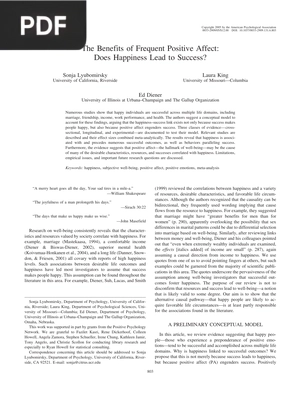
A landmark review arguing that happiness does not just follow success, it helps produce it. Pulls together cross-sectional, longitudinal, and experimental evidence across work, health, and relationships.
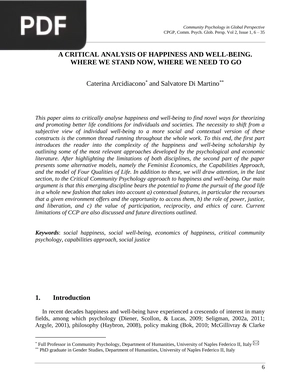
A critical look at how happiness and well-being are usually defined, and an argument for moving from a purely individual view to a social and contextual one. Brings in feminist economics and the capabilities approach.
A chapter on what actually makes people happy or unhappy at work, and why that spills into overall quality of life. Reviews the models available and where they fall short.
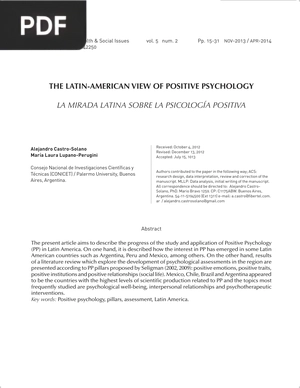
A review of how positive psychology has developed outside its original setting, with the local research lines, instruments, and cultural differences in how well-being is understood.
Alejandro Castro-Solano and María Laura Lupano-Perugini
A two-page handout that defines the field, breaks happiness into its three components, and lists practical strategies to raise each one. The fastest overview here.
Optimists and pessimists read the same events in different ways, and that habit can be changed. These books explain how explanatory styles work and what happens when you shift yours.
A study of 275 participants testing whether optimism can be raised through a self-help intervention, and how much of the gain in well-being it explains. Includes the full method and results.
A concise entry by one of the researchers who defined dispositional optimism, covering expectancy-value models, how optimism shapes coping, and what it predicts for health and persistence.
A course unit that separates dispositional optimism, learned optimism, and unrealistic optimism, then does the same for hope. Ends with how both are measured and developed.
A plain-language guide to how optimists and pessimists read the same events differently, and what the research says you can do about it. Pairs optimism with gratitude practice.
A study module on optimism and pessimism as predictions about the future, covering explanatory styles, realistic versus unrealistic optimism, and how pessimism can be shifted.
Ten concrete habits for keeping a positive outlook, each tied back to research such as the broaden-and-build theory of positive emotions. Short and immediately usable.
Gratitude is the most studied practice in positive psychology, and one of the cheapest to try. These materials cover the research behind it and the exercises that come out of it.
A white paper reviewing two decades of gratitude research: what gratitude is, where it comes from, what it does for health and relationships, and how it can be cultivated. The most complete treatment of the topic here.
Eight ready-to-run gratitude practices, from the gratitude letter and journal to savoring walks and team huddles, each with instructions, timing, and the research behind it. Built for health care teams but usable anywhere.
American Nurses Foundation and Greater Good Science Center
How gratitude practice applies to mental health work, both for the people being cared for and for the staff doing the caring. Part of a series on applying well-being research in nursing.
A short practitioner guide to the kindness intervention: how to set it up, how often it should be repeated, and what the evidence says about its effect on the person doing the kind act.
A 24-chapter workbook that turns the research into weekly practice, with exercises on gratitude, strengths, savoring, meaning, and resilience. The author released it free for anyone who wants to use it.
A 30-day program with one practice per day, covering self-awareness, gratitude, mindfulness, savoring, and self-care. Every day has space to write, so the workbook doubles as a journal.
Eight coaching tools for building resilience and cutting stress, including how to find clarity and focus, identify your sources of anxiety, and interrupt unhelpful thinking styles. Designed to be used with a team or on your own.
A workbook built around the five evidence-based actions that improve day to day well-being: connect, be active, take notice, keep learning, and give. Each one comes with prompts to plan your own changes.
Every person leans on a handful of signature strengths. These texts explain the 24 VIA character strengths and the six virtues behind them, plus how to put yours to work.
A designed guide that takes each of the 24 character strengths and shows how it plays out in a manager or team member, including what it looks like when overused. Practical and well illustrated.
Line Blackburn, Pascale Lemaire, Sylvie Ménard and Jacques E. Tremblay
A review of every instrument used to measure character strengths, across age groups and settings, with the strengths and limits of each. Starts with a clear introduction to the classification itself.
A study of how mindfulness and character interact to produce happiness at work, and why the effect depends on where a person starts from. Open access research with the full analysis included.
A placebo-controlled trial comparing what happens when you train your signature strengths versus your weakest ones, followed up over the long term. Answers a question practitioners argue about constantly.
René T. Proyer, Fabian Gander, Sara Wellenzohn and Willibald Ruch
A test of whether the 24 strengths really group into the six virtues the classification assigns them to, judged by 70 experts and 41 laypeople. Includes the full table of strengths and definitions.
The study that grounded the six core virtues by tracing them through Confucianism, Taoism, Buddhism, Hinduism, Athenian philosophy, Judaism, Christianity, and Islam. The historical foundation of the whole classification.
Katherine Dahlsgaard, Christopher Peterson and Martin E. P. Seligman
A short piece on using your character strengths to choose work that fits, rather than reshaping yourself to fit the work. A readable entry point to the topic.
Books on Positive Relationships and Social Connection
Strong relationships are the single best predictor of well-being in most studies. These books cover empathy, social connection, and the skills that keep a relationship healthy.
A full doctoral dissertation on whether empathy can be deliberately trained, with several intervention studies and their results. The most in-depth treatment of empathy in this collection.
A chapter on the social and emotional skills that make relationships work: communication, conflict, compassion, inclusion, and resisting pressure. Written with young people in mind but applicable well beyond that.
A study of 260 university students testing how social connection feeds flourishing, and how hopelessness gets in the way. Open access with the full statistical model.
A short review separating empathy from sympathy and from emotional intelligence, and arguing that empathic communication is a skill that can be taught. Written for people in caring roles.
Positive psychology at work is about more than morale surveys. These titles look at engagement, career purpose, work and family balance, and which stress interventions actually help.
How five constructs from the field, strengths, positive emotions and flow, gratitude, calling, and hope, can be used to help people build a career with purpose. Includes concrete counseling techniques.
A practical review of what managers can actually do to help people balance work and personal life, drawing on positive communication, role modeling, and relationship building.
A review of how well-being at work benefits the person and the organization at the same time, covering engagement, resources, and the conditions that make gains mutual rather than one-sided.
An argument for how the field should be trained and regulated, and what happens to clients when anyone can claim the title. Relevant to anyone thinking about practicing professionally.
A chapter reviewing which workplace stress interventions actually raise well-being, separating what targets the individual from what targets the job itself.
Schools were among the first places positive psychology was tested at scale. These papers cover positive education in the classroom, in higher education, and why some programs fade after the first year.
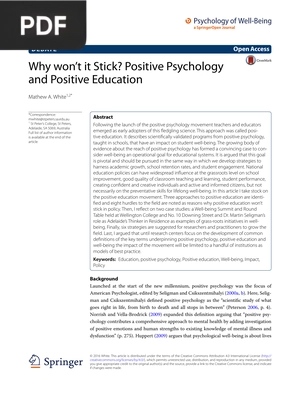
The paper that defined positive education, written by the founder of the field, with evidence from controlled studies that resilience and engagement can be taught in school.
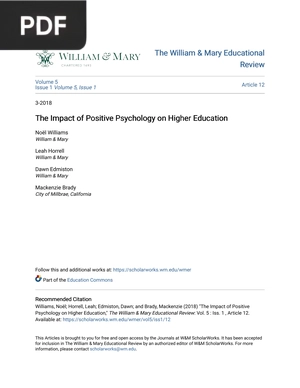
How the ideas of the field are being applied on university campuses, from course design to student support, and what results have been measured so far.
Noël Williams, Leah Horrell, Dawn Edmiston and Mackenzie Brady
Send this page to someone who’d love to read it. Everything is free, no sign-up needed.
Esc
Start typing to search...
Searching...
No results found
Try different search terms
Your book is downloading!
If InfoBooks helped you, you can support us in one click: add us as a preferred source on Google. You'll see more of our books when you search, and you'll help us keep sharing free reading with everyone.
Done! Your book is downloading
Know someone who’d enjoy reading it? Send them this page. It’s free, no sign-up needed, and you help us spread the love of reading.